AI Agents
How Do We Handle KYC for Autonomous Corporate Agents?
Rethinking identity verification in agentic finance
For decades, financial identity systems have relied on a simple assumption:
there is a human on the other side of the transaction.
Know Your Customer (KYC) frameworks were built to answer familiar questions:
Who are you?
Are you authorized to transact?
Are you a sanctioned or risky counterparty?
Who ultimately owns or controls this account?¹
The operating model was straightforward.
A person opens an account. A company verifies beneficial ownership. A regulated institution performs identity checks. Permissions flow from verified legal actors.
Autonomous AI systems complicate this model.
Because increasingly, software may initiate actions traditionally reserved for employees:
purchasing software licenses
paying vendors
managing procurement
initiating treasury actions
reconciling payments
executing financial workflows
This introduces a new infrastructure problem:
How do we verify an autonomous system acting on behalf of a company?
More specifically:
How do we handle KYC for autonomous corporate agents?
The answer is likely not:
KYC the AI.
The answer is:
verify delegated authority.
Traditional KYC assumptions begin to break
Modern KYC frameworks assume accountable legal actors.
A regulated institution generally verifies:
a natural person
a legal entity
beneficial ownership
authorized signatories
sources of funds
sanctions exposure¹²
Identity verification mechanisms reflect this assumption.
Passports.
Biometrics.
Government IDs.
Tax identifiers.
Corporate registration documents.
But autonomous agents possess none of these.
An AI procurement system has:
no legal identity
no passport
no beneficial ownership
no independent accountability
Yet in emerging financial systems, agents may still be authorized to:
move money
issue payments
transact with vendors
trigger procurement workflows
This creates a conceptual mismatch.
Traditional KYC verifies:
who you are
Agentic finance increasingly requires systems to verify:
who authorized you to act
That distinction matters.
Because autonomous systems are not economic principals.
They are delegated operators.
The misconception: “KYC the AI”
One of the more common framing errors around agentic commerce is the assumption that AI agents themselves require traditional identity verification.
This framing is likely incorrect.
An autonomous corporate agent is not a legal person.
It cannot independently:
own assets
bear liability
satisfy regulatory obligations
assume fiduciary responsibility
Instead, autonomous agents function more like software employees operating under delegated authority.
A better mental model looks like:
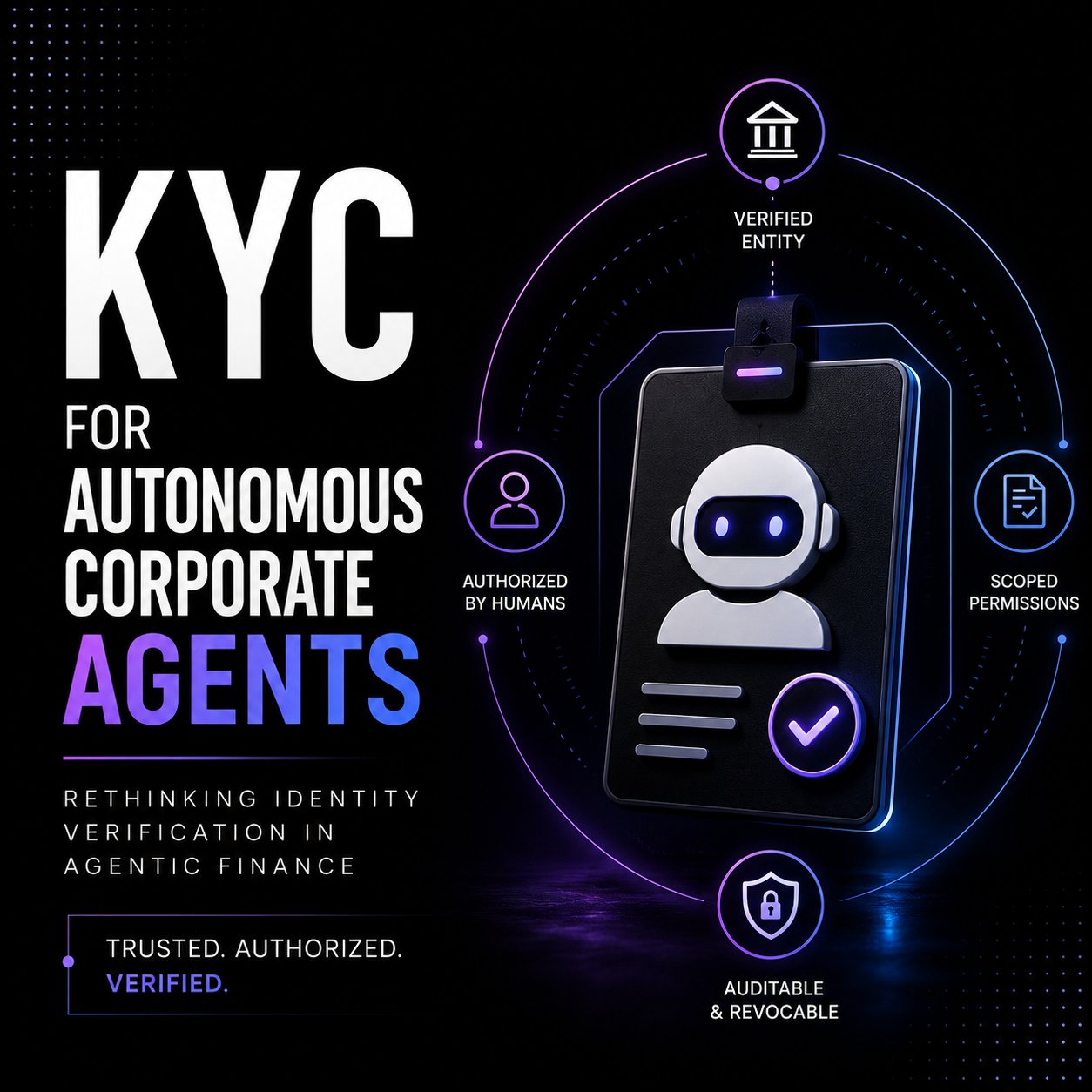
Human identity → corporate verification → delegated permissions → agent execution³
In practice:
The company is verified.
Responsible humans are verified.
Authority is delegated to software operating inside clearly defined boundaries.
This looks far closer to enterprise authorization systems than consumer identity verification.
A useful comparison is enterprise SaaS.
An employee does not receive unlimited system access simply because employment exists.
Permissions are assigned.
Access is constrained.
Authority is revocable.
Financial systems increasingly appear headed toward a similar model for autonomous software.
Identity shifts from personhood to authorization
The deeper implication is that identity infrastructure may evolve from proving personhood toward proving authorization.
Historically:
identity = authentication
Increasingly:
identity = authenticated delegation
In other words:
The critical question becomes:
What is this agent allowed to do, who approved it, and under what constraints?
A compliant architecture for autonomous financial agents would likely require:
Verified corporate identity
The underlying company still undergoes standard onboarding:
KYB (Know Your Business)
beneficial ownership verification
sanctions screening
AML controls¹²
Nothing changes at this layer.
Verified human authority
Specific individuals remain accountable.
Examples:
CFO
controller
procurement lead
treasury operator
These humans delegate permissions to software agents.
Accountability remains human.
Scoped permissions
Agents receive narrowly bounded authority.
Examples:
merchant restrictions
spend thresholds
task limitations
expiration windows
geography restrictions
transaction categories⁴
The system shifts from:
unrestricted autonomy
to:
policy-constrained execution
Revocable authority
Permissions must be reversible immediately.
If:
suspicious behavior occurs
an employee leaves
a policy changes
an agent malfunctions
access should disappear instantly.⁵
This increasingly resembles the principle of least privilege, a long-standing cybersecurity model in which systems receive only the minimum access necessary to complete a task.⁶
Agentic finance appears likely to inherit this philosophy.
The emerging trust architecture for corporate agents
If autonomous corporate agents become common, KYC infrastructure will likely evolve into something closer to machine trust infrastructure.
Several patterns are already emerging.
Delegated credentials
Instead of storing raw payment credentials, agents receive scoped access tokens or temporary permissions tied to approved workflows.⁴
An AI procurement system may receive authorization to:
renew cloud software subscriptions
without gaining authority to:
initiate treasury transfers
This distinction becomes operationally important.
Cryptographic authentication
Agent actions increasingly require verifiable provenance:
Which agent initiated this request?
Which company authorized it?
Which human approved the delegation?
Emerging architectures increasingly rely on cryptographic identity systems, signed credentials, and policy frameworks to prove trusted execution.³⁵
Auditability and observability
Autonomous execution without traceability is unlikely to survive compliance review.
Every action must remain observable:
transaction history
approval trails
permission logs
revocation history
behavioral monitoring⁵
In regulated finance:
explainability matters
The future compliance question becomes:
Why did this agent take this action?
not:
Did AI make a decision?
Zero-trust assumptions
Security frameworks increasingly assume:
systems fail
This is important.
Agentic finance will likely optimize around bounded failure, not perfect intelligence.⁵
The assumption becomes:
an agent may eventually make mistakes
Therefore:
permissions, monitoring, escalation paths, and controls matter more than raw autonomy.
What a compliant autonomous corporate agent might actually look like
Imagine a procurement agent inside a mid-market software company.
Its job:
renew approved SaaS contracts.
The permission model may look something like:
Authorized by: CFO of Acme Inc.
Purpose: SaaS procurement only
Spend threshold: $500 per transaction
Allowed merchants: AWS, Datadog, OpenAI, Notion
Escalation rule: Human approval required above threshold
Expiration: 30 days
Auditability: Full logging enabled
Revocation: Immediate
Notice something important:
The system never “KYC’d the AI.”
Instead:
it verified authority surrounding the AI
That distinction feels foundational.
Why this matters for fintech
Much of the discussion around agentic commerce focuses on intelligence.
How capable are the models?
Can agents negotiate?
Can agents transact?
Those questions matter.
But in financial services, trust infrastructure may matter more.
The hard problem is unlikely to be:
can software spend money?
The harder problem becomes:
how do institutions trust software to spend money safely?
That is ultimately a KYC, authorization, and identity problem.
And increasingly, fintech infrastructure appears to be moving toward:
verified, observable, delegated software execution
rather than:
autonomous financial actors.
A PMM takeaway
The strongest fintech companies in this category are unlikely to position themselves around:
autonomous finance
or:
AI agents that transact
The more compelling narrative is:
trusted execution within human-defined boundaries
Because buyers rarely purchase autonomy.
They purchase:
control
compliance
accountability
reduced operational friction
The companies that win this category will not merely enable AI agents to transact.
They will make institutions comfortable letting them transact.
Footnotes
Financial Action Task Force (FATF) Digital Identity Guidance
FinCEN Customer Due Diligence Requirements
National Institute of Standards and Technology (NIST) Digital Identity Guidelines
Written by Josh Popkin. Published May 25, 2026.
Disclaimer: The views expressed here are my own and are intended for informational purposes only. Nothing on this site constitutes financial, investment, or legal advice. Please do your own research and consult appropriate professionals when making decisions.