Payments
Mastercard’s BitLicense Approval: A Strategic Bet on the Future of Payments
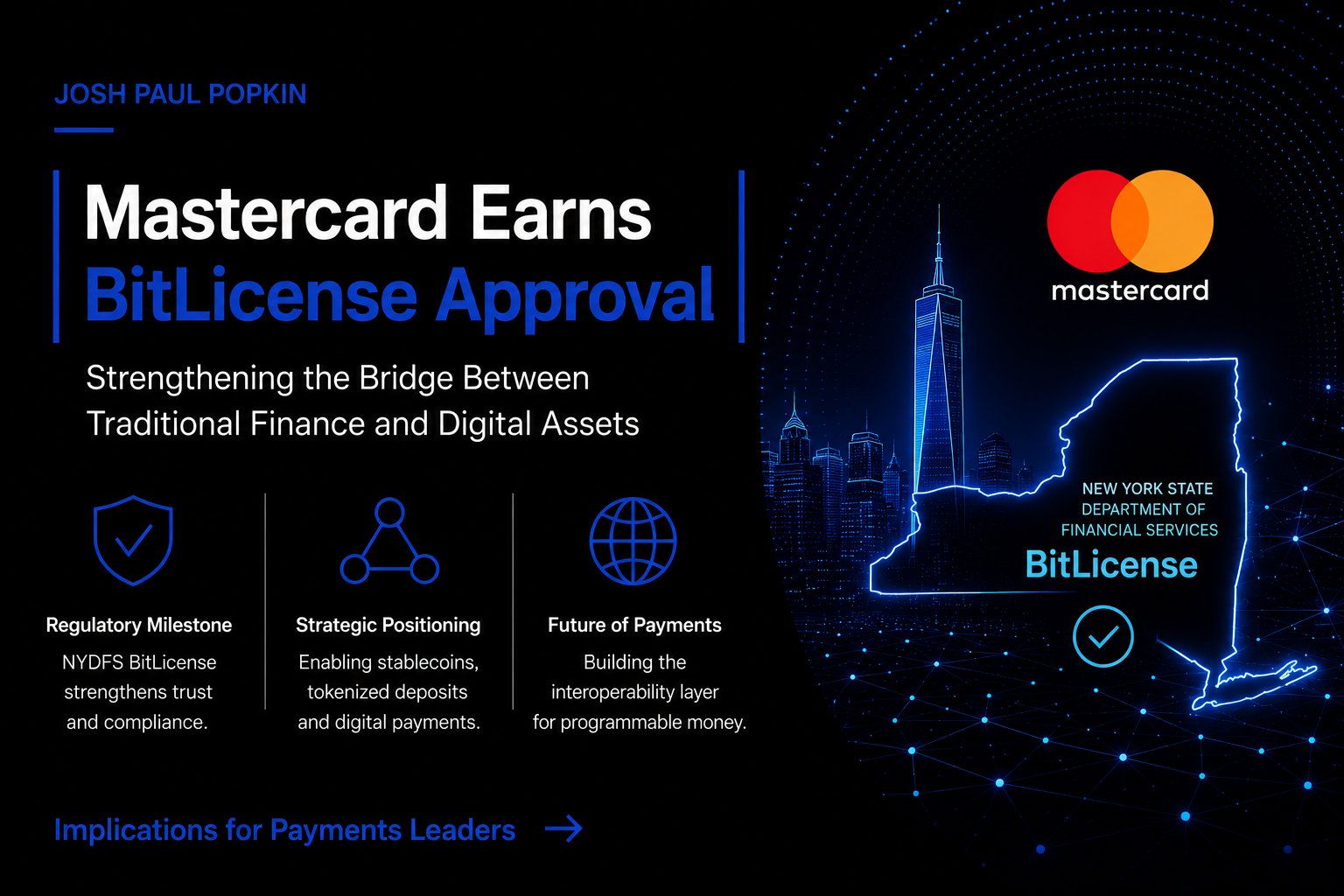
Mastercard’s recent approval for a New York State Department of Financial Services (NYDFS) BitLicense is more than a regulatory milestone—it is a signal of where the future of global payments is heading.
Written by Josh Paul Popkin. Published June 14, 2026.
Mastercard’s recent approval for a New York State Department of Financial Services (NYDFS) BitLicense is more than a regulatory milestone—it is a signal of where the future of global payments is heading.¹
On May 27, 2026, Mastercard Transaction Services (U.S.) LLC received a BitLicense from NYDFS, one of the most rigorous digital asset regulatory frameworks in the United States. The license authorizes Mastercard to engage in regulated virtual currency activities in New York, a jurisdiction widely viewed as the gold standard for digital asset oversight.²
From a strategic perspective, the approval strengthens Mastercard’s positioning at the intersection of traditional financial infrastructure and emerging blockchain-based payment networks. The company explicitly stated that the license supports its long-term strategy around digital currencies, including stablecoins and tokenized deposits.³
The timing is notable. Stablecoin transaction volumes exceeded $27 trillion globally in 2024, surpassing the combined annual transaction volume of Visa and Mastercard for the first time, according to research from Castle Island Ventures and Brevan Howard Digital.⁴ While much of that activity remains concentrated in crypto-native ecosystems, the direction of travel is clear: programmable money is moving closer to mainstream financial services.
Mastercard has spent several years building the rails necessary to participate in this transition. The company has launched Crypto Credential, enabled stablecoin settlement pilots, partnered with digital asset infrastructure providers, and developed tokenization capabilities that can bridge blockchain networks with existing payment systems.⁵ The BitLicense provides regulatory certainty that allows Mastercard to expand these efforts under one of the most demanding supervisory regimes in the world.
For investors, the key takeaway is that Mastercard is not attempting to replace its existing network. Rather, it is positioning itself to become the trusted interoperability layer between traditional finance and digital assets. This mirrors the company’s historical strategy: monetize payment flows regardless of underlying technology while maintaining leadership in trust, compliance, and network effects.
The broader implication is that digital assets are increasingly becoming a payments infrastructure story rather than a speculative asset story. As stablecoins, tokenized bank deposits, and blockchain settlement systems mature, competitive advantage may shift from asset issuance to distribution, compliance, and network connectivity. Mastercard’s BitLicense approval suggests the company intends to play a central role in that future.
In many ways, the announcement is less about cryptocurrency and more about preserving Mastercard’s relevance in the next generation of money movement.
Footnotes
Mastercard Investor Relations, "Mastercard Granted New York State Department of Financial Services BitLicense," May 27, 2026.
New York State Department of Financial Services, Virtual Currency Business Licensing Framework.
Mastercard stated that the approval aligns with its strategy to support payment and settlement infrastructure for stablecoins and tokenized deposits.
Castle Island Ventures & Brevan Howard Digital, The State of Stablecoins 2025 (reported stablecoin transaction volume exceeding $27 trillion during 2024).
Mastercard digital asset initiatives and stablecoin infrastructure strategy.