Fintech
Stripe’s Next Advantage Is Its Network
What Stripe Sessions reveals about the company’s evolution beyond payments infrastructure
What Stripe Sessions reveals about the company’s evolution beyond payments infrastructure
At Stripe Sessions this year, Stripe announced a vast mix of product updates: instant Treasury transfers, stablecoin support, programmable treasury infrastructure, and new ways for businesses to move money globally.
Individually, these launches are easy to view as incremental improvements.
Taken together, they reveal something more important:
Stripe is no longer just building payments infrastructure. It is building a financial network for businesses.
That distinction matters.
Infrastructure helps companies process transactions. Networks become more valuable as participation increases. And at Stripe’s scale, the implications are strategic.
Stripe is already behaving like a network
One statistic from Sessions reframes the conversation.
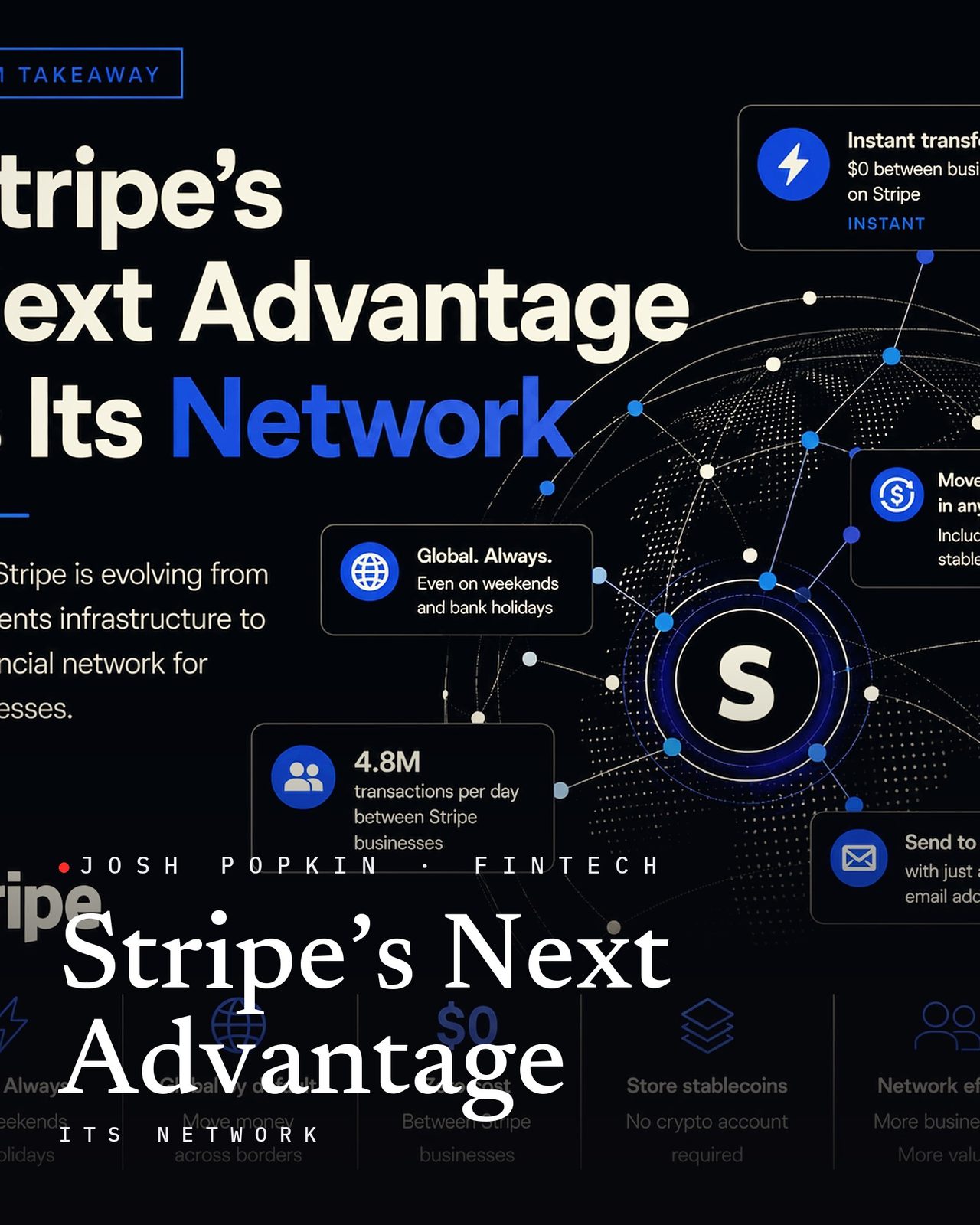
Stripe shared that one Stripe business pays another approximately 4.8 million times per day.
At that level of interaction, Stripe is no longer functioning solely as a payments layer.
It is already operating like a network.
The product strategy is now catching up to that reality.
Historically, Stripe’s value proposition was straightforward:
make accepting payments easier
Over time, that expanded into fraud prevention, global expansion, revenue optimization, and treasury management.
Now the ambition is broader:
make Stripe the environment where businesses move and manage money.
That is an important shift in positioning.
Because once a payments company becomes the place where money lives and moves, its role in the financial stack changes.
Instant Treasury transfers reveal the strategy
The clearest example came from Treasury.
Stripe announced that businesses on the Stripe network can now transfer funds between Treasury accounts instantly and at zero cost.
The significance is not simply faster transfers.
It is what faster transfers enable.
If two companies already operate on Stripe, money can move immediately between them without traditional banking friction:
no settlement delays
no waiting for business days
no weekend interruptions
no added transfer costs
In finance, those expectations are not normal.
The strategic advantage is deeper than speed.
Stripe is reducing friction between counterparties already inside its ecosystem.
That is classic network design.
Participation improves the product.
Every additional business increases the utility of the system for everyone else.
Stripe is expanding from payments into financial operations
The broader Treasury roadmap makes the ambition clear.
Payments companies traditionally focus on accepting and routing money.
Stripe is increasingly focused on the entire operating layer around money:
treasury management
stored balances
global transfers
programmable financial workflows
multi-currency movement
stablecoin-enabled settlement
At Sessions, Stripe framed stablecoins around operational efficiency rather than crypto speculation, highlighting use cases including B2B payments, payroll, remittances, and high-velocity money movement.
This positioning is important.
Stripe is not asking businesses to care about crypto.
It is asking them to care about better financial operations.
Faster settlement.
Continuous availability.
Reduced friction.
Global interoperability.
The technology matters far less than the operational outcome.
That is strong product positioning.
Stripe is simplifying identity in business payments
One of the more important product signals in Sessions came during a Treasury demo.
Stripe showed an agent recognizing that a recipient already had a Stripe profile and routing payment instantly through the network.
The implication extends beyond the demo.
Cross-border business payments remain operationally fragmented. Businesses still navigate routing numbers, settlement systems, bank instructions, currency compatibility, and varying transfer speeds.
Stripe is simplifying that complexity by turning participation in the network into infrastructure.
If counterparties are already on Stripe, sending money becomes dramatically simpler.
The experience begins to feel less like banking and more like software.
That distinction matters.
Software sets different expectations.
Faster.
Cleaner.
Always available.
Predictable.
The language Stripe used matters
Near the end of Sessions, Stripe described its strategy as “activating the Stripe network.”
That wording is deliberate.
Not payments platform.
Not financial tooling.
Network.
Networks create reinforcing advantages.
If businesses increasingly:
accept payments on Stripe
hold balances on Stripe
manage treasury on Stripe
transact with counterparties on Stripe
automate workflows through Stripe
then switching costs become more than technical.
They become operational.
Leaving no longer means replacing an API.
It means leaving a financial environment where counterparties, liquidity, and workflows already exist.
That is a significantly stronger position.
A PMM takeaway
The most important takeaway from Stripe Sessions was not any single product launch.
It was the product narrative emerging underneath them.
Stripe is moving beyond helping businesses process money.
It is positioning itself as infrastructure for how businesses operate financially.
That changes the story.
The value proposition becomes larger than:
process payments
It becomes:
move, manage, and program business money more effectively
For fintech product marketers, this is a useful reminder that category shifts rarely happen through a single announcement.
They emerge through accumulation.
Products change first.
Positioning becomes visible later.
At Stripe, that positioning is becoming increasingly clear.
Its next competitive advantage is unlikely to come from payments alone.
It will come from the network built around them.
Footnotes
Stripe Sessions 2026 keynote: Stripe business-to-business payment frequency and instant Treasury transfers.
Stripe Sessions 2026 keynote: stablecoin use cases for B2B payments, payroll, remittances, and high-velocity money movement.
Stripe Sessions 2026 keynote: Stripe network activation and strategic framing.
This article was written by Josh Popkin, published on May 25, 2026.