Fintech
The New Fraud Problem in Fintech Isn’t Payments. It’s Usage.
What Stripe Sessions 2026 revealed about multi-account abuse, free-trial gaming, and the economics of AI monetization
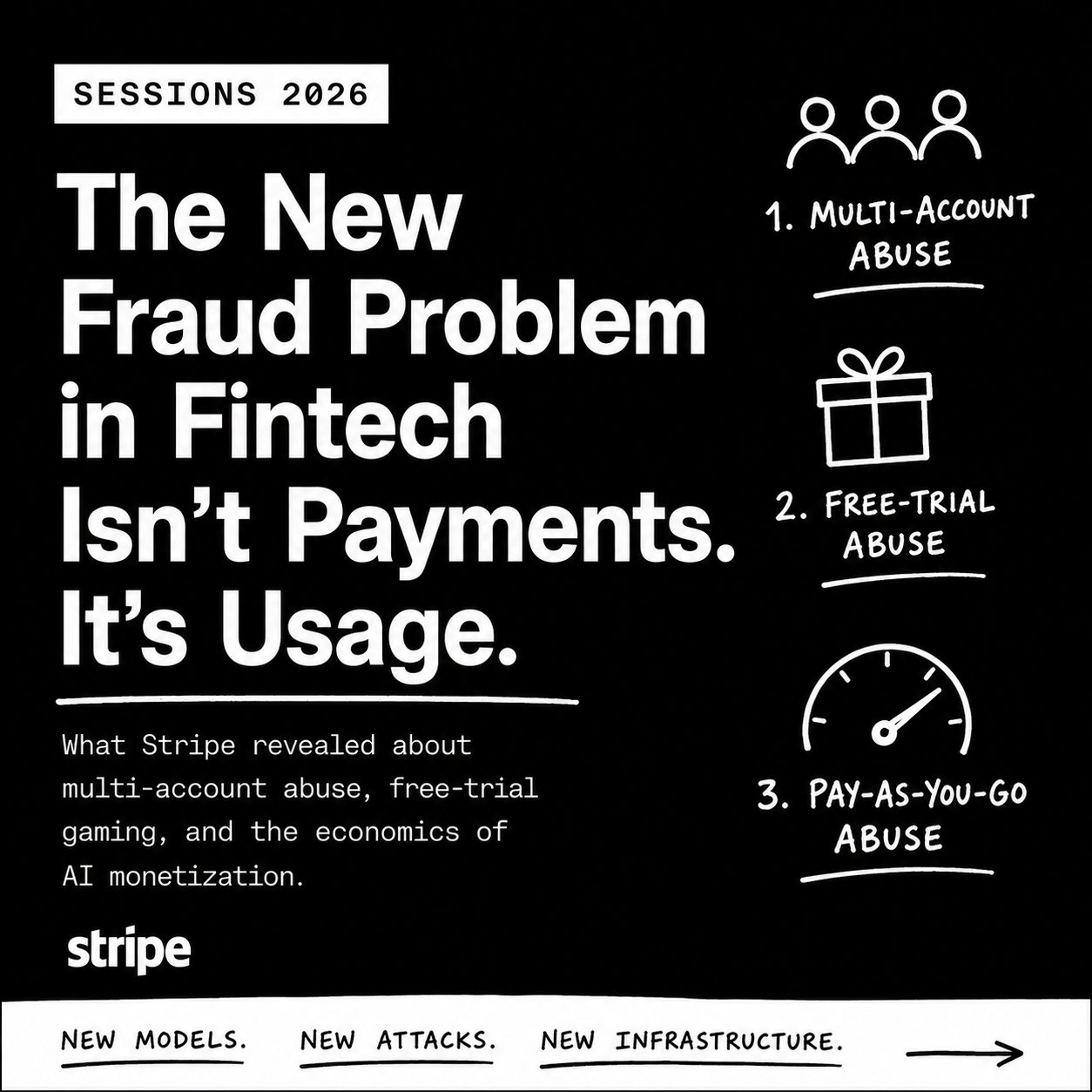
Yesterday’s fraud playbook was relatively straightforward: stop stolen cards, block chargebacks, reduce payment disputes.
Tomorrow’s fraud problem looks different.
At Stripe Sessions 2026, amid announcements about AI agents, stablecoins, and global payments infrastructure, Stripe spent meaningful time discussing something less flashy but arguably more important: abuse in AI-native business models.¹ The framing was subtle, but the implication was significant.
As software pricing evolves—from subscriptions to usage-based billing, token consumption, credits, and agentic workflows—fraud evolves with it.
The core challenge is no longer simply “Did this payment go through?”
It becomes:
“Did someone consume value they never intended to pay for?”
That shift matters for every fintech, SaaS platform, and product marketer building around AI.
Fraud Changes When Monetization Changes
For most internet businesses, fraud historically centered on payment rails: stolen cards, account takeovers, synthetic identities, friendly fraud, or merchant disputes.
But AI companies are introducing a different economic model.
Instead of paying $50/month for software access, customers increasingly consume value incrementally:
Tokens
API calls
Compute time
Agent execution
Usage-based credits
Pay-as-you-go inference
Stripe described this directly during Sessions, noting that “AI is creating entirely new terrain for fraud,” while simultaneously reshaping how businesses monetize.²
That observation deserves more attention than it received.
Because when pricing becomes dynamic and real-time, abuse becomes dynamic and real-time too.
1. Multi-Account Abuse: The Identity Arbitrage Problem
Stripe highlighted multi-account abuse as a major category of emerging fraud.³
The pattern is familiar to growth teams but increasingly sophisticated:
A bad actor creates multiple accounts to repeatedly extract value—free credits, subsidized compute, promotional offers, onboarding incentives, or token allowances.
In subscription software, this might have looked like opening multiple email addresses for repeated free trials.
In AI systems, the economics become far more consequential.
A user can:
Farm onboarding credits
Rotate identities after limits are reached
Steal or resell access tokens
Create synthetic accounts to evade throttling
The challenge is not just identity verification.
It is economic intent verification.
Is this a legitimate new customer?
Or the same actor repeatedly extracting subsidized value?
Stripe’s answer appears to be ecosystem intelligence.
During Sessions, executives described using data from across the Stripe network to identify abusive behavior before losses occur, effectively shifting fraud prevention from reactive detection to predictive prevention.⁴
That matters because Stripe sits at unusual scale.
The company says it now serves more than 5 million businesses globally, processes roughly $1.9 trillion in payment volume, and supports businesses responsible for the equivalent of 1.6% of global GDP.⁵ At that scale, abuse patterns become visible faster.
One merchant might miss suspicious behavior.
A network can identify it.
This resembles a broader shift already underway in fraud prevention: using shared behavioral signals rather than isolated merchant-level data.
The future fraud moat may not be a better rules engine.
It may be better network visibility.
2. Free-Trial Abuse: Growth Loops Become Attack Surfaces
Free trials have historically been a growth strategy.
Increasingly, they are also an attack surface.
Stripe explicitly called out free-trial abuse during Sessions as part of a broader shift in first-party fraud behavior.⁶
For SaaS businesses, the incentive problem is obvious.
The better your onboarding economics become, the more attractive exploitation becomes.
AI intensifies this dynamic because free usage often has a meaningful marginal cost.
Every generated image, inference request, API completion, or token bundle costs money to deliver.
This creates a strange inversion:
The products growing fastest may also be easiest to exploit.
In a traditional SaaS model, giving away 14 extra days of access might be annoying but manageable.
In AI infrastructure, repeated abuse can mean real compute expense.
Industry data suggests the scale is meaningful. According to estimates from the Association of Certified Fraud Examiners, organizations lose roughly 5% of annual revenue to fraud, though the composition increasingly includes first-party abuse and digital exploitation.⁷ Meanwhile, fraud-prevention vendors increasingly describe promotional abuse, account cycling, and repeat free-trial creation as a growing category of online loss.⁸
For fintech PMMs and growth teams, this creates a messaging challenge.
We tend to market frictionless onboarding:
Start instantly. No commitment. Free credits included.
But frictionless onboarding and fraud prevention increasingly pull in opposite directions.
The winning companies may not be those with the least friction.
They may be the companies best at graduated trust—minimizing friction for good actors while raising it for suspicious ones.
3. Pay-As-You-Go Abuse: The “Dining and Dashing” Problem
The most interesting fraud concept from Sessions was Stripe’s framing of what executives jokingly described as the digital equivalent of **“dining and dashing.”**⁹
The problem emerges in usage-based systems.
A customer consumes value in real time but fails to pay after the fact.
In the keynote demo, Stripe described a scenario in which an AI customer burns tokens while approaching spending limits. A trustworthy user may simply need additional access, but a malicious user might intentionally consume resources and disappear before payment
settles.¹⁰
Stripe’s example focused on tokenized AI consumption, but the idea generalizes.
Imagine:
API-heavy developer products
AI copilots billed on usage
Compute marketplaces
Agentic workflows running autonomously
Consumption-based fintech infrastructure
Every one of these models risks a version of the same question:
How much credit do you extend before payment certainty exists?
This is effectively a modern accounts receivable problem disguised as product design.
Stripe’s response—streaming payments tied directly to token consumption through stablecoin infrastructure—may sound futuristic, but the strategic logic is straightforward: reduce the gap between consumption and settlement.¹¹
In other words:
Don’t bill later.
Settle continuously.
Whether stablecoins become the dominant mechanism matters less than the principle.
The closer payment moves toward usage, the smaller the abuse window becomes.
Why This Matters Beyond Stripe
It would be easy to dismiss this as a Stripe-specific infrastructure story.
That would be a mistake.
What Stripe surfaced at Sessions is a broader economic shift:
Fraud models evolve alongside monetization models.
Subscription businesses created subscription fraud.
Marketplace businesses created marketplace fraud.
Embedded finance created synthetic identity and onboarding abuse.
AI-native businesses are now creating usage abuse.
That changes how companies think about:
Risk systems
Pricing design
Identity verification
Customer lifecycle marketing
Product onboarding
Billing infrastructure
It also changes positioning.
Increasingly, trust and fraud prevention are not back-office concerns.
They are product features.
For fintech PMMs, this creates a useful reframing:
The future differentiation story may not simply be speed, conversion, or growth.
It may be:
How safely can customers grow without being exploited?
Stripe’s keynote offered a glimpse of that future.
Not a world where fraud disappears.
A world where infrastructure becomes smart enough to predict abuse before value is extracted.
Notes
Stripe, Stripe Sessions 2026: Opening Remarks & Product Keynote Transcript, April 29, 2026, pp. 4–5.
Ibid., p. 4.
Ibid., pp. 4–5.
Ibid., p. 5.
Stripe, Stripe Sessions 2026: Opening Remarks & Product Keynote Transcript, April 29, 2026, p. 5; Stripe, “Everything We Announced at Sessions 2026,” Stripe Blog, April 2026.
Stripe, Stripe Sessions 2026: Opening Remarks & Product Keynote Transcript, p. 5.
Association of Certified Fraud Examiners, Occupational Fraud 2024: A Report to the Nations (Austin, TX: Association of Certified Fraud Examiners, 2024).
Sift, Q1 2025 Digital Trust & Safety Index; Signifyd, annual fraud trend reporting on promotional abuse and first-party fraud.
Stripe, Stripe Sessions 2026: Opening Remarks & Product Keynote Transcript, p. 5.
Ibid.
Ibid., p. 5.