AI
What Can Small Franchise Owners in NYC Use AI For?
Non-technical franchise owners in NYC get the fastest return from AI in four places: smarter local demand forecasting, customer service automation, marketing content built for…
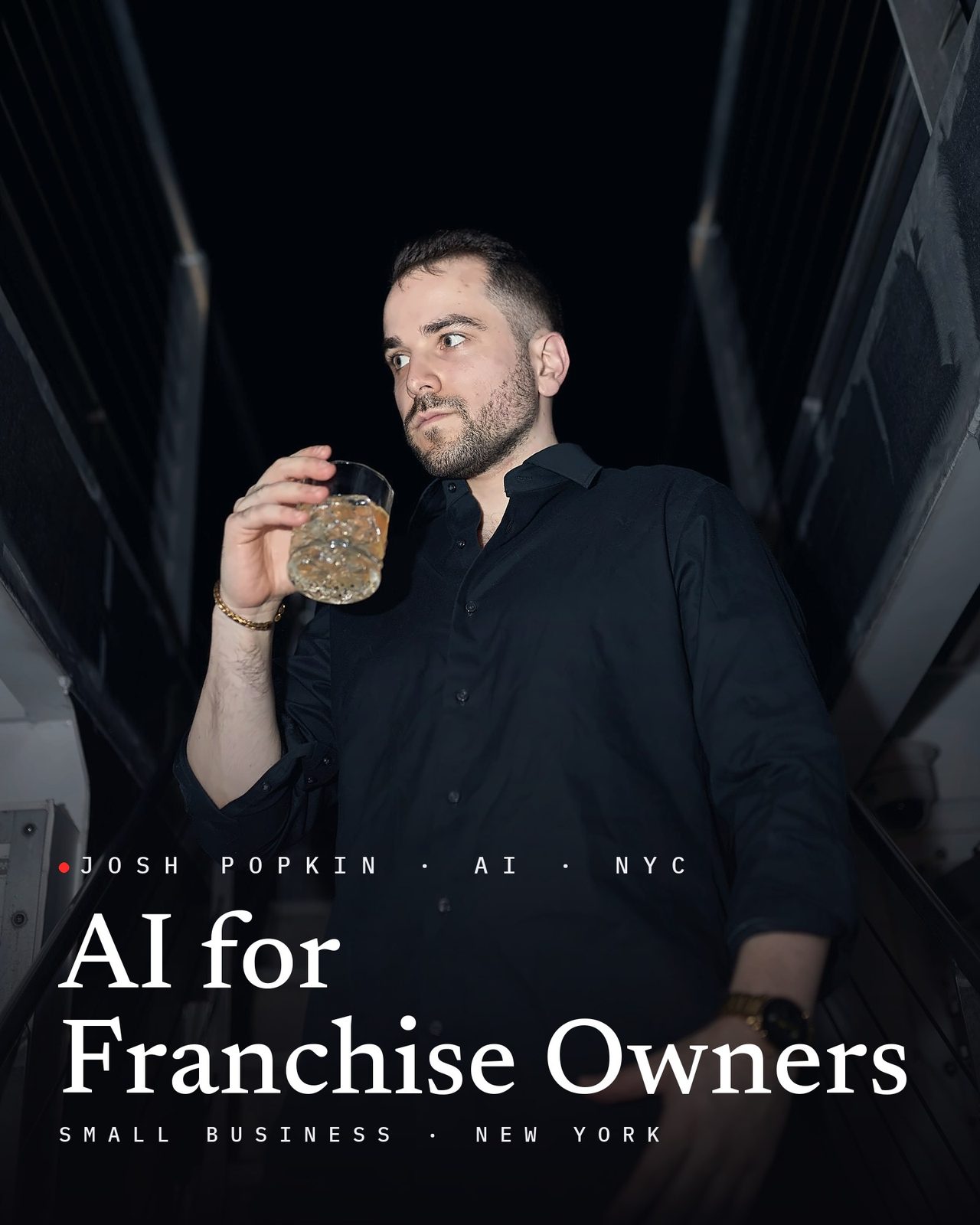
By Josh Popkin, MBA
Non-technical franchise owners in NYC get the fastest return from AI in four places: smarter local demand forecasting, customer service automation, marketing content built for their specific neighborhood, and faster, evidence-based decision-making on staffing, inventory, and pricing. None of this requires technical skill — modern AI tools are built for exactly this kind of operator: if you can use a smartphone, you can run these systems.
Why Does This Matter Specifically for a Franchise Owner, Not Just Any Small Business?
Franchise owners sit in a unique spot. You're running an independent business, but you're not building strategy from scratch — you're executing a proven model in a hyperlocal market, competing against other operators (some franchisees, some independents) fighting for the same block, the same lunch rush, the same Google searches. In NYC specifically, that means competing in one of the most saturated, highest-cost small business environments in the country, where small edges in decision-making compound fast across rent, staffing, and margin.
The data on this is direct: franchise companies using AI report a 45% increase in operational efficiency, and the honest framing from operators who've done this at scale is that the technology sounds complex, but using it isn't — most AI tools built for franchise operations work like any other business software, no IT department required.
Where Should a Non-Technical Owner Actually Start?
Not with a five-tool overhaul. The clearest pattern across every credible study of small business AI adoption is the same: start with one focused tool solving your single biggest pain point, prove the return, then expand. That's not caution for caution's sake — it's the actual difference between owners who get real results and the roughly half who stay stuck "exploring" AI indefinitely without ever changing a workflow.
For a NYC franchise owner specifically, four starting points stand out:
1. Smarter decision-making on staffing and inventory. This is the highest-leverage, lowest-glamour win. AI-driven forecasting tools can flag patterns a busy owner won't have time to spot manually — which days truly need an extra staff member, which inventory items are quietly overstocked, which slow hours are actually consistent enough to cut shifts around. This is exactly the kind of "boring win" that pays back fastest, well before flashier tools do.
2. Customer service automation. A chatbot or automated response system handling reservation questions, hours, and basic complaints frees up an owner's own time for the decisions only a human can make — and franchises running these systems report meaningfully faster response times and higher satisfaction when a person stays available for anything complicated.
3. Marketing built for your specific neighborhood, not a generic template. A go-getter owner doesn't need a marketing department — they need AI tools that can draft locally-specific social posts, respond to reviews, and generate content fast enough to actually compete with independents who move quicker than corporate. This is the single most widely adopted small business use case nationally, and it's also the one where NYC's hyperlocal competition rewards speed the most.
4. Financial visibility. A growing share of small business owners are using AI tools for bookkeeping and financial management — not to replace an accountant, but to catch a margin problem or cash flow issue two weeks earlier than a monthly spreadsheet review would.
Do You Need to Understand the Technology to Use It Well?
No — and this is the point worth repeating for a non-technical, go-getter owner who might assume otherwise. The businesses seeing real results aren't the most technical ones. The pattern that shows up again and again: one motivated person in the business — often the owner — spends deliberate, regular time (weeks, not a certification course) actually using one tool on one real problem, measuring what happens, and only then deciding whether to expand. That's a mindset any driven operator already has. It's the same instinct that built the business in the first place, aimed at a new tool.
The one discipline worth building in early: treat AI output as a first draft, not a final answer. The owners who ran into real trouble were the ones who published or acted on AI output without a quick gut-check first — a habit, not a skill, and an easy one for an experienced operator to build.
What's the Realistic First 90 Days?
Pick one problem — a scheduling headache, a review-response backlog, a demand pattern you've been guessing at for a year. Pilot one tool against it. Measure the result in real numbers: hours saved, complaints resolved faster, a labor cost trimmed. Then, and only then, decide what to add next. Franchise operators who've scaled AI successfully describe this exact sequence — prove it small, let the result do the persuading, expand from evidence rather than hype.
For a driven NYC franchise owner, that's the actual opportunity here: not becoming a technologist, but using a handful of accessible tools to make faster, better-informed calls than the guy running the same concept three blocks away who's still doing it all from memory and gut feel.
Citations
"How AI Will Transform Franchise Operations in 2026: What Business Owners Need to Know Now." Franchise Creator, 26 Feb. 2026, https://franchisecreator.com/how-ai-will-transform-franchise-operations-in-2026-what-business-owners-need-to-know-now/.
Ricci, Tommaso Maria. "AI for Franchises: The 2026 Playbook for Operators." Tommaso Maria Ricci, 25 Jun. 2026, https://www.tommasomariaricci.com/blog/ai-for-franchises-operator-playbook.
"AI in Small Business: 2026 Adoption and Trust Outlook." Simply Business, 17 Jun. 2026, https://www.simplybusiness.com/resource/small-businesses-are-using-ai-but-theyre-not-letting-it-run-the-show-2026-outlook/.
"Small Business AI Adoption: 68% Use It, Most Wing It." Digital Applied, 22 Feb. 2026, https://www.digitalapplied.com/blog/small-business-ai-adoption-guide-2026.