Banking
Who Actually Buys Banking-as-a-Service?
Mapping the Real Decision-Makers in Embedded Finance..
Mapping the Real Decision-Makers in Embedded Finance
In Banking-as-a-Service (BaaS), “the buyer” is rarely a single role.
For providers like Cross River Bank, Celtic Bank, Sutton Bank, Evolve Bank & Trust, the decision to adopt a banking partner is distributed across multiple functions — each owning a different part of the evaluation journey, from product feasibility to regulatory approval to financial viability.
Understanding this buying committee is critical for how embedded finance products are positioned, sold, and ultimately scaled.
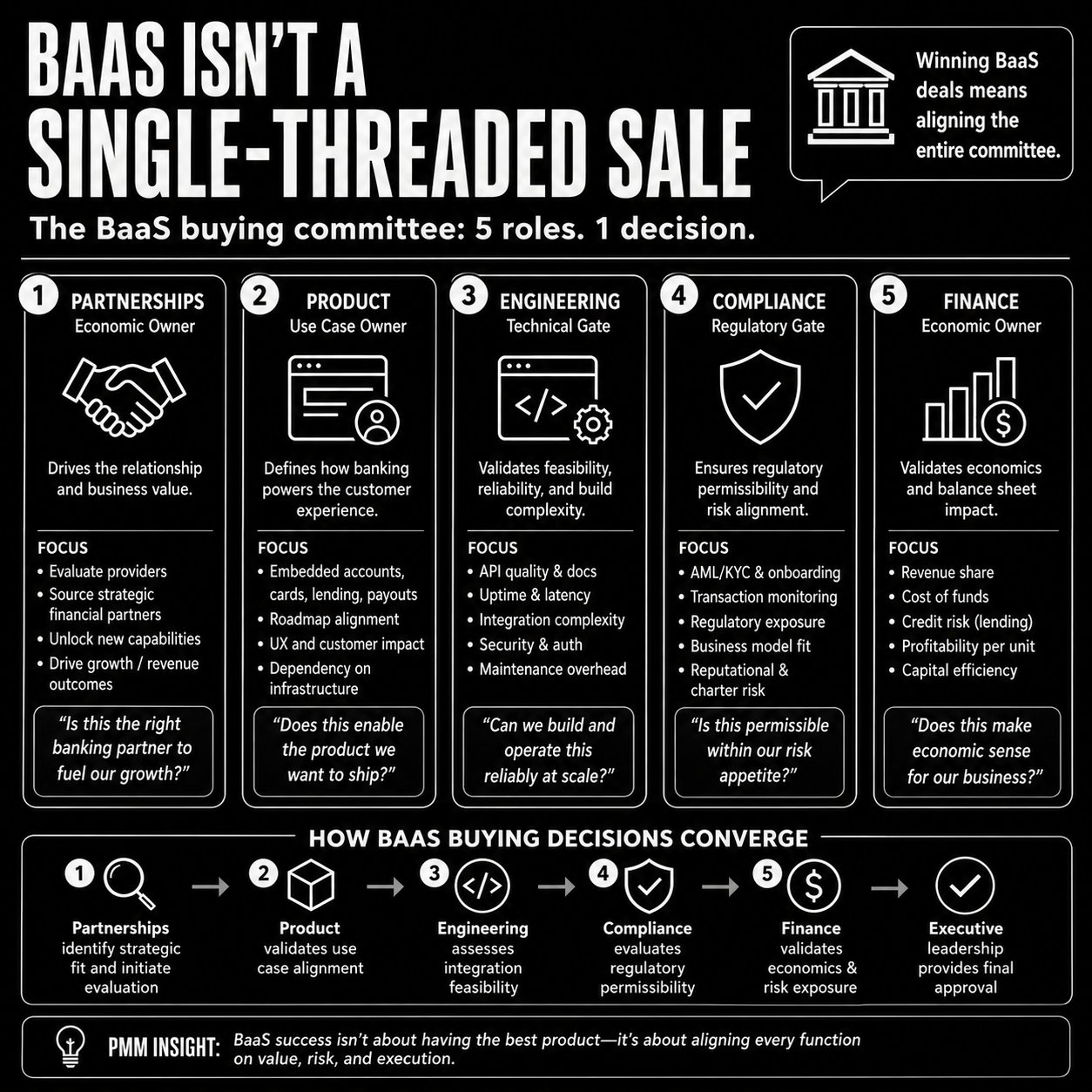
BaaS is not a single-threaded sale
Banking-as-a-Service is a multi-threaded enterprise decision involving:
Product (what gets built)
Engineering (what can be built)
Compliance (what is allowed)
Finance (what is viable)
Partnerships (what gets prioritized)
No single stakeholder owns the decision end-to-end — success depends on alignment across all five.
1. Head of Partnerships / Strategic Partnerships (economic owner)
In most fintech organizations, the Head of Partnerships or VP Partnerships acts as the primary business driver of a banking relationship.
They are typically responsible for:
evaluating banking infrastructure providers
sourcing strategic financial partnerships
accelerating product expansion via new capabilities
owning revenue or growth outcomes tied to embedded finance
They often initiate engagement with providers and serve as the internal champion throughout the process.
PMM insight: This is the true “economic buyer” in most BaaS deals.
2. Product leadership (use case definition owner)
The VP Product or Head of Product defines how banking capabilities translate into customer-facing features.
They evaluate:
feasibility of embedded accounts, cards, lending, payouts
alignment with product roadmap
user experience constraints introduced by banking rails
dependency on third-party infrastructure
Their core question:
“Does this enable the product we want to ship?”
If the answer is no, the partnership typically stalls regardless of commercial interest.
3. Engineering leadership (technical feasibility gate)
The CTO or Head of Engineering owns technical validation and integration feasibility.
They evaluate:
API architecture and documentation quality
uptime, latency, and system reliability
integration complexity and maintenance overhead
security, authentication, and compliance implementation requirements
While engineering rarely drives vendor selection, they often serve as a hard gate for execution readiness.
4. Compliance, Risk, and Legal (regulatory gatekeepers)
In BaaS, compliance is not a downstream function — it is a core decision layer.
Compliance and risk teams evaluate:
AML/KYC and onboarding requirements
transaction monitoring obligations
regulatory exposure by use case
permissible business model alignment
reputational and banking charter risk
PMM insight: Many deals that are “greenlit” commercially are ultimately blocked here due to risk tolerance constraints.
5. Finance (economic validation owner)
The CFO or finance leadership evaluates the unit economics and balance sheet implications of the partnership.
They focus on:
revenue share structures
cost of funds and lending exposure
credit risk (for lending use cases)
profitability per account / transaction
capital efficiency of embedded financial products
In lending-heavy fintechs, finance often becomes a central approval layer rather than a late-stage formality.
6. CEO / Founder (strategic alignment layer)
At early-stage fintech companies, the CEO often initiates the relationship and drives urgency.
However, as companies scale, ownership shifts to functional leaders, with the CEO stepping in primarily for:
strategic partnerships
major product expansions
high-risk regulatory decisions
How BaaS buying decisions actually converge
In practice, adoption follows a structured multi-thread alignment process:
Partnerships identify strategic fit and initiate evaluation
Product validates use case alignment
Engineering assesses integration feasibility
Compliance evaluates regulatory permissibility
Finance validates economics and risk exposure
Executive leadership provides final approval
Only when all layers align does a banking partner get selected.
Implications for go-to-market teams
The key misconception in BaaS GTM is treating it as a single-threaded sale.
In reality, success depends on:
multi-threaded stakeholder engagement
tailored messaging by function
early compliance and engineering alignment
clear articulation of both product enablement and risk posture
Providers that win in this space are not just “better banks” — they are better at aligning complex internal buying committees across product, risk, engineering, and finance simultaneously.