Fintech
Why Autonomous Commerce Changes B2B Fintech More Than Retail
Everyone thinks autonomous commerce is a retail story. You can see why.
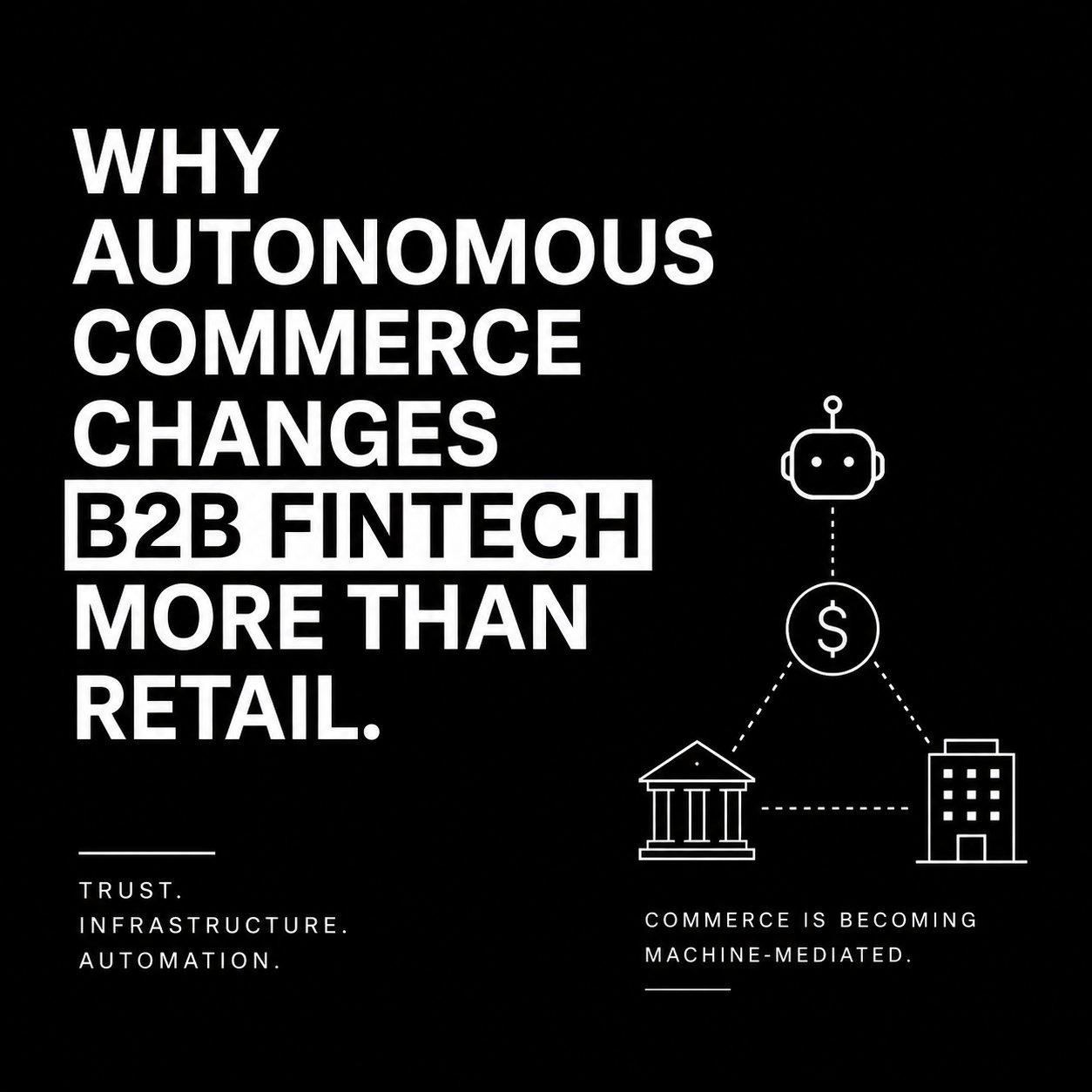
Everyone thinks autonomous commerce is a retail story.
You can see why.
The demos are flashy: an AI assistant finds sneakers, compares prices, checks reviews, and buys them without you opening ten tabs. Payment giants are already racing to support this future. Visa has introduced infrastructure for AI-mediated purchasing through Intelligent Commerce, while Mastercard is building agent-driven payment systems aimed at trusted autonomous transactions.¹ ²
The narrative is intuitive: shopping, but automated.
But I think that framing misses the bigger shift.
Autonomous commerce is not primarily about consumers buying faster.
It is about systems making decisions.
And when systems start making decisions, B2B fintech becomes far more important than retail.
The Wrong Mental Model
Most people imagine autonomous commerce as a prettier checkout flow.
Human intent → AI recommendation → purchase.
But that’s too narrow.
The real change is delegation.
Instead of a person manually deciding every action, software gets permission to operate within boundaries.
“Find me the cheapest flight under $700.”
“Renew vendor software if price increases stay below 8%.”
“Automatically source replacement inventory from approved suppliers.”
“Reconcile invoices and execute payment if contract terms match.”
Suddenly, commerce becomes less about clicks and more about rules.
And rules are where B2B systems live.
Retail companies optimize persuasion.
B2B fintech companies optimize trust.
That distinction matters more than people realize.
Commerce Gets Automated Faster Than Trust
One reason people overestimate retail disruption is because consumer experiences are easier to imagine.
An AI shopping assistant feels futuristic.
But autonomous spending breaks the moment trust breaks.
Consumers tolerate recommendation mistakes.
They do not tolerate unauthorized payments.
Businesses tolerate inefficiency.
They do not tolerate financial ambiguity.
This is why the first meaningful wave of autonomous commerce will likely emerge in areas with structure, permissions, auditability, and clear rules—not impulse shopping.
Think procurement.
Accounts payable.
Treasury workflows.
Vendor management.
Expense controls.
Subscription management.
Invoice reconciliation.
In other words: infrastructure-heavy workflows already mediated by fintech systems.
Even recent payment network announcements quietly point in this direction. Visa’s Intelligent Commerce messaging increasingly emphasizes tokenization, authentication, spend controls, and agent permissions rather than magical shopping experiences.³
Mastercard has similarly framed agentic payments around trust, standards, identity, and controlled authorization.²
That is a very B2B story.
Autonomous Commerce Is Really an Infrastructure Problem
The popular version of autonomous commerce focuses on interfaces.
The real version is infrastructure.
An autonomous system cannot simply “buy things.”
It needs answers to difficult questions:
Who authorized this action?
What spending limits exist?
Can an agent negotiate but not execute payment?
What happens when terms change?
Which vendors are approved?
How are disputes resolved?
What identity does an agent possess?
Who is liable if something goes wrong?
These sound less like ecommerce questions and more like payments, compliance, fraud, identity, and treasury questions.
That should feel familiar to anyone close to enterprise fintech.
Because most of enterprise fintech exists to solve trust problems at scale.
Payments infrastructure, identity systems, fraud controls, spend management, procurement tooling, reconciliation layers, APIs, audit logs, permissions architecture—these become exponentially more important when software starts spending money.
In a strange way, autonomous commerce makes fintech more invisible and more essential at the same time.
Consumers may notice the AI.
Businesses will care about the rails underneath it.
The New Buyer Is Part Human, Part Machine
There is another reason B2B fintech stands to benefit.
The buyer changes.
For years, digital commerce optimized for humans.
Good branding.
Clean UX.
Persuasive copy.
Landing pages.
Pricing psychology.
But autonomous commerce introduces a second customer: software.
That software does not care about emotional positioning.
It cares about structured data.
Permission frameworks.
Reliable APIs.
Machine-readable pricing.
Policy constraints.
Confidence signals.
Availability.
Authentication.
A procurement agent comparing five vendors will not “feel” inspired by a beautiful homepage.
It will likely prioritize certainty.
Can this provider integrate?
Are contracts machine-readable?
Is pricing predictable?
Are policies programmable?
Can payment authorization be delegated safely?
In practice, that means fintech companies increasingly compete on operational clarity.
The winners may not simply have the best product.
They may have the most machine-readable business.
This is already becoming visible in early discussions around agentic commerce. Research from McKinsey argues that commerce is shifting toward environments where AI increasingly mediates decisions, requiring businesses to become more interoperable, structured, and machine-consumable.⁴
The future funnel may look strange:
Human approves strategy.
Machine evaluates vendors.
Human sets guardrails.
Machine executes.
Fintech validates trust.
Retail Will Change—But More Slowly Than People Think
To be clear, retail absolutely changes.
AI-assisted shopping feels inevitable.
Visa and Mastercard would not be investing heavily if they thought otherwise.¹ ²
But retail has an adoption problem.
Consumers are emotional buyers.
People say they want automation until trust is tested.
You might let AI reorder toothpaste.
You may even trust it to find flights.
But will you let it buy a $4,000 vacation package? A luxury watch? A wedding gift?
Maybe eventually.
Probably not immediately.
Enterprise behavior looks different.
Companies already automate financial workflows.
They already delegate permissions.
They already operate through procurement systems and policy engines.
Autonomous commerce in enterprise settings feels less like a leap and more like an extension.
From:
“This workflow requires approval”
to:
“This workflow executes automatically within approval thresholds”
That is a much smaller behavioral jump.
The Real Moat: Trust Architecture
For years, fintech companies competed on speed.
Faster onboarding.
Faster settlements.
Faster approvals.
Faster payments.
Autonomous commerce changes the equation.
Now the advantage shifts toward trust architecture.
Who can safely let software transact?
Who can verify intent?
Who can tokenize credentials?
Who can establish identity between agents, merchants, and financial systems?
Who can create auditable permissions?
Who can resolve disputes?
The companies quietly building these primitives may end up owning disproportionate value.
Not because consumers know their names.
But because autonomous systems rely on them.
One of the more revealing details in recent payment-network activity is how much emphasis sits on standards, trusted-agent protocols, authentication layers, and permissions—not AI itself. The intelligence is important.
But intelligence without trust is unusable.⁵
That feels like an underrated lesson.
We may remember autonomous commerce as an AI story.
But underneath, it increasingly looks like a fintech infrastructure story.
And infrastructure stories tend to reward the companies nobody notices until everything depends on them.
Footnotes
Visa, “Enabling AI agents to buy securely and seamlessly” (Visa Intelligent Commerce), 2025.
Mastercard, “Mastercard Agent Pay: secure, scalable and trusted agentic AI payments,” 2025–2026.
Visa, “Visa Opens the Door to AI-Driven Shopping for Businesses Worldwide,” April 2026.
McKinsey & Company, The Agentic Commerce Opportunity: How AI Agents Are Ushering in a New Era for Consumers and Merchants, October 2025; and The Automation Curve in Agentic Commerce, January 2026.
Visa, “Visa Intelligent Commerce: Enabling Trusted AI-Driven Payments,” 2025; Mastercard, “Mastercard Agent Pay: Secure, Scalable and Trusted Agentic AI Payments,” 2025.
This article was written by Josh Popkin on May 25, 2026.