Fintech
Why Great Fintech Feels Invisible
What Revolut reveals about the evolution from financial app to global infrastructure layer.
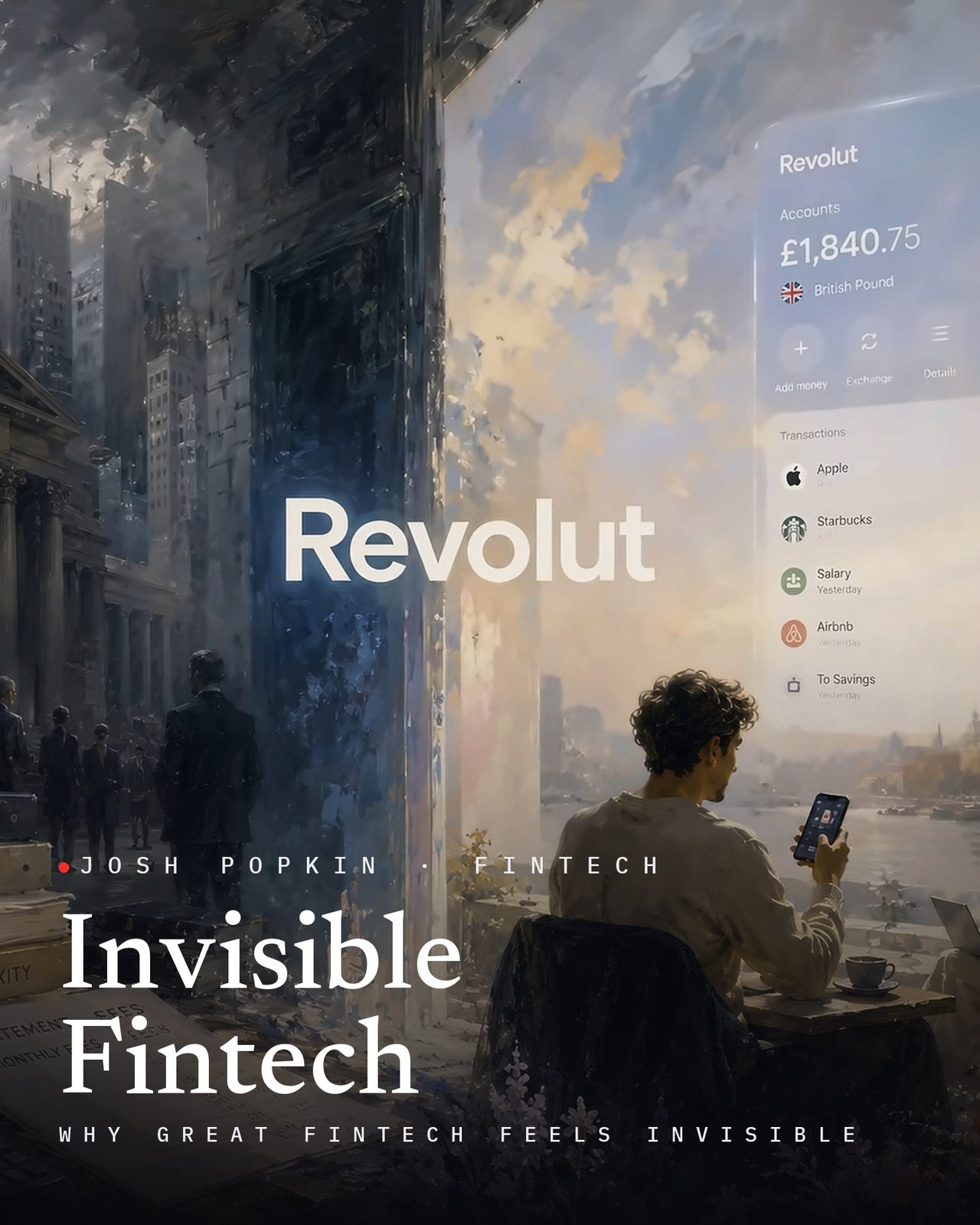
What Revolut reveals about the evolution from financial app to global infrastructure layer.
For the better part of the last decade, fintech companies sold consumers on a simple promise: banking, but faster.
Faster onboarding. Faster transfers. Faster approvals. Better interfaces. Sleeker cards. Cleaner apps.
And for a while, that was enough.
Legacy banks were bloated, branch-centric institutions wrapped in outdated software and hidden fees. The new generation of fintech startups arrived with neon gradients, minimalist design systems, and slogans about “reimagining finance.”
But listening to Revolut founder Nik Storonsky describe the company on David Rubenstein's show, something more interesting emerges.
Revolut no longer sounds like a fintech app.
It sounds like infrastructure.
That distinction matters because it reveals where the entire industry may be heading next.
The Best Fintech Products Reduce Cognitive Load¹
One of the most revealing moments in the interview comes when Storonsky repeatedly describes Revolut in nearly identical terms:
“Everything in one simple app.”
At first glance, that sounds like generic product language. But beneath it sits a deeper strategic philosophy.
Consumers do not actually want financial products.
They want fewer financial decisions.
Nobody wakes up excited about:
foreign exchange mechanics
treasury management
payment routing
banking rails
multi-currency settlement
regulatory compliance
People want:
money to work everywhere
fewer fees
less friction
fewer apps
less uncertainty
The winning fintech experience is increasingly about abstraction.
The complexity still exists. In many cases, it grows more complicated every year. But the user experiences less of it.
That is the product.
Research increasingly supports this idea. Studies on digital financial behavior have shown that high cognitive load increases confusion, emotional decision-making, and distrust in online financial environments.¹ Experimental trust research has similarly found that people exhibit lower levels of trust under cognitive strain.²
In this sense, the future of fintech may not be defined by feature expansion, but by invisible complexity management.
Revolut’s Original Insight Was Economic Transparency
The original Revolut proposition was brutally simple.
Banks were charging consumers hidden spreads and fees on foreign exchange. Storonsky noticed it personally while traveling and sending money abroad.
His insight was not philosophical. It was mathematical.
Consumers were losing roughly $50–70 for every $1,000 exchanged.
That specificity mattered.
Many fintech companies market themselves through abstraction:
“empowering consumers”
“democratizing finance”
“reimagining banking”
Revolut initially grew through something much more concrete:
here is the hidden fee
here is how much you are losing
here is a better alternative
According to Storonsky, the company spent almost nothing on marketing for its first several years. Growth came through word of mouth.
That only happens when the value proposition is instantly understandable.
The strongest fintech positioning often does not feel like branding at all. It feels like economic clarity.
The Interface Is Changing. The Infrastructure Is Becoming the Moat.
Perhaps the most important strategic insight in the interview comes during the discussion around AI.
Storonsky describes large language models not as a replacement for banking infrastructure, but as another interface layer sitting on top of it.
That framing is subtle but extremely important.
The interface layer will continue to evolve:
mobile apps
voice assistants
chat interfaces
AI agents
But underneath those surfaces sits the real asset:
compliance systems
licensing
payment rails
fraud infrastructure
treasury systems
operational reliability
regulatory relationships
Most fintech marketing still focuses heavily on the visible layer:
UI
cards
aesthetics
lifestyle branding
But the enduring enterprise value increasingly lives beneath the interface.
This is one reason many fintech companies begin to resemble infrastructure businesses as they mature.
The novelty fades.
The systems remain.
Fintech Starts With Convenience. It Scales Through Trust.³
Early-stage fintech companies often compete on speed and simplicity.
But eventually, scale introduces a different challenge: trust.
Storonsky explicitly notes that becoming a public company increases credibility because public institutions are generally perceived as more trustworthy.
That statement reflects a broader evolution occurring across fintech.
At the beginning, consumers adopt new financial products because they are:
cheaper
faster
easier
Over time, they stay because they become dependable.
The emotional transition is important:
novelty attracts users
trust retains them
Research from Edelman has consistently shown that financial services remains one of the least trusted sectors globally, despite improvements over the past decade.³ Meanwhile, fintech-specific trust studies show consumers still trust traditional financial institutions more than digital-only finance brands, particularly around security, regulation, and data privacy.⁴
This is why mature fintech companies increasingly emphasize:
security
reliability
compliance
global licensing
operational uptime
Not because innovation disappeared, but because financial services ultimately operate on confidence.
Consumers can tolerate glitches in social media apps.
They do not tolerate uncertainty around money.
The Endgame Is the Financial Operating System
Another revealing section of the interview comes when Storonsky describes the fragmentation businesses currently face.
A company may use:
one provider for acquiring
another for banking
another for payroll
another for treasury management
another for payouts
Revolut’s ambition is to consolidate these layers into a single integrated system.
This reflects a broader pattern across technology markets.
Many successful companies evolve through the same sequence:
Feature → Tool → Platform → Operating System
The most important fintech companies are increasingly competing to become financial operating systems.
Not merely apps.
Not merely banks.
But integrated coordination layers for economic activity itself.
That is a much larger ambition.
Fintech’s Future May Belong to Invisible Companies
The irony of financial technology is that the most successful companies may become less visible over time.
As infrastructure improves, the experience feels simpler.
As systems become more powerful, they fade further into the background.
The consumer does not think about:
payment routing
currency conversion
compliance orchestration
treasury infrastructure
They simply expect things to work.
That expectation may ultimately define the next era of fintech.
The winners will not necessarily be the companies with the flashiest interfaces or the loudest branding.
They will be the companies capable of absorbing extraordinary complexity while presenting users with something that feels effortless.
In other words, the future of fintech may look less like software and more like electricity:
critical, invisible, and everywhere.
Footnotes:
1 Hemish Prakash Chandra Kapadia, “Reducing Cognitive Load in Online Financial Transactions,” International Journal of Current Science (2022), accessed May 13, 2026, International Journal of Current Science paper.
2 Katarzyna Samson and Patrycjusz Kostyszyn, “Effects of Cognitive Load on Trusting Behavior – An Experiment Using the Trust Game,” PLOS One 10, no. 5 (2015), accessed May 13, 2026, PLOS One study.
3 Edelman, “2019 Trust in Financial Services,” Edelman Trust Barometer (2019), accessed May 13, 2026, Edelman Trust Barometer 2019.
4 Andrew Wilde, “Why Consumers Just Don’t Trust Fintechs,” Edelman Insights, August 26, 2020, accessed May 13, 2026, Edelman fintech trust article.