Fintech
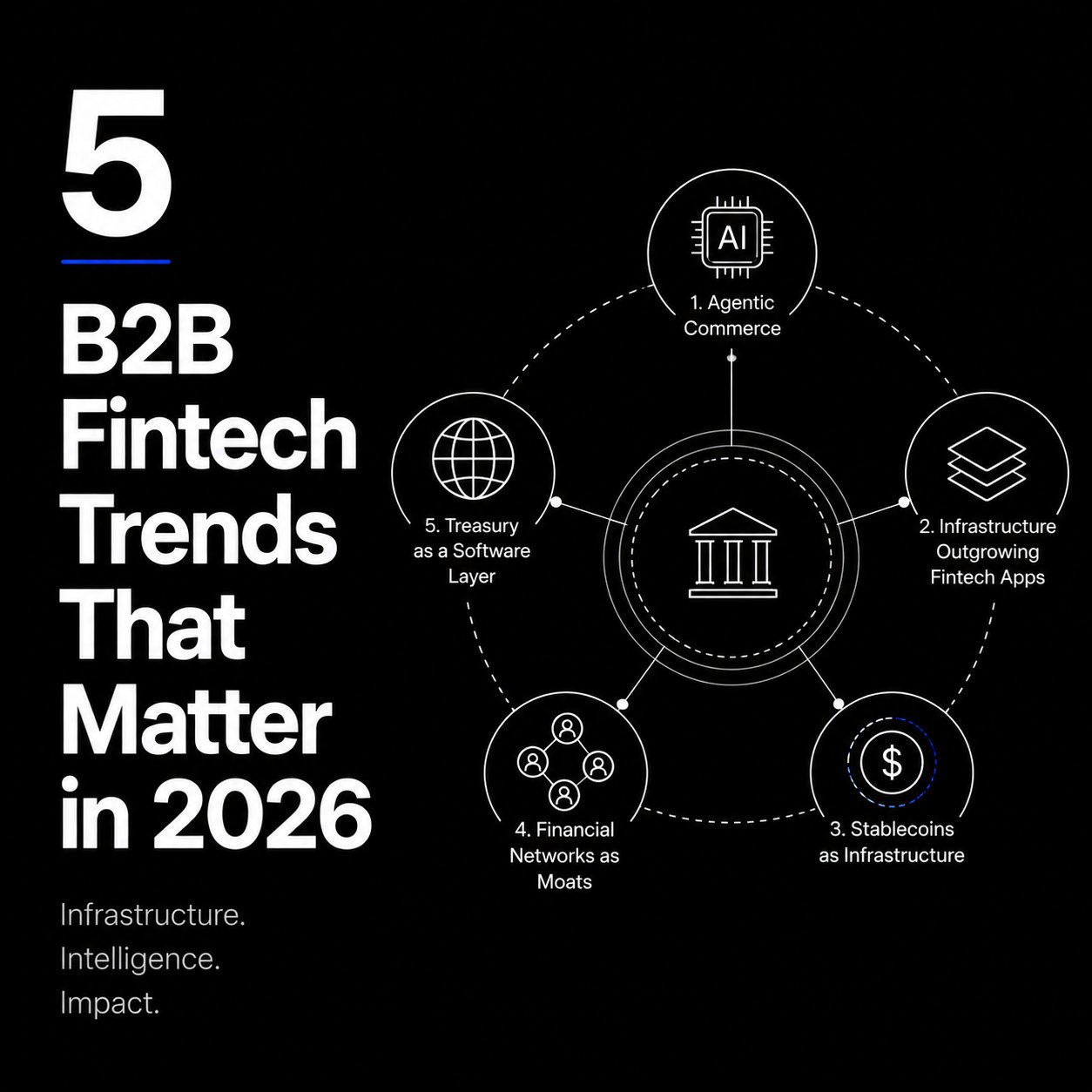
Five Structural Shifts Reshaping B2B Fintech
The trends changing payments, treasury, infrastructure, and financial software in 2026
For much of the last decade, fintech was defined by disruption.
Build a better banking app.
Replace the incumbent.
Own the customer relationship.
Compete on experience.
That era is not over. But in B2B fintech, the center of gravity has shifted.
The most important changes in financial services are increasingly happening beneath the interface: inside treasury systems, payment orchestration layers, bank infrastructure, AI-enabled workflows, and money movement networks.¹
In other words:
B2B fintech is becoming less about reinventing finance and more about rebuilding the infrastructure underneath it.
The most important trends right now reflect that transition.
1. Agentic Commerce Requires New Financial Rails
For years, AI in fintech remained advisory.
Financial copilots summarized information.
Fraud systems surfaced recommendations.
Automation accelerated workflows.
But humans still executed the transaction.
That boundary is changing.
AI systems are beginning to move from recommendation to execution.²
An agent no longer simply suggests:
renew the software license
It renews the software license.
It books travel.
Pays invoices.
Purchases cloud resources.
Executes procurement.
This introduces a new infrastructure problem:
How does software transact safely?
Traditional payment rails were designed around human behavior:
manual authorization
identity verification
visible checkout experiences
direct human intent
Agentic systems require something different:
delegated permissions
scoped payment credentials
transaction limits
auditability
revocable access
This is why payment companies are increasingly building infrastructure for AI-native transactions.
Stripe recently introduced agent-oriented financial tooling, including Link wallets for agents and Issuing for Agents, allowing platforms to provision tightly scoped payment credentials for software rather than exposing underlying cards or accounts.³
Meanwhile, payment networks including Visa and Mastercard are increasingly investing in frameworks for trusted agent-driven commerce.⁴
The shift matters because AI adoption in financial workflows will ultimately scale at the speed of trust.
The technical challenge is no longer:
Can agents transact?
It is:
Can businesses trust them to?
2. Infrastructure Providers Are Capturing More of Fintech’s Value
For most of the 2010s, fintech growth followed a familiar formula:
Build a consumer financial product for a niche audience.
A neobank for freelancers.
A card for creators.
A bank for immigrants.
A better budgeting app.
A lending platform for SMBs.
The assumption was clear:
fintech startups would displace slow-moving incumbents.
But the strongest growth in fintech increasingly sits behind the scenes.
Infrastructure providers — not challenger brands — are capturing more of the industry’s value creation.⁵
Companies such as Modern Treasury, Plaid, Mambu, and Thought Machine are not attempting to replace banks.
They are selling software to modernize them.
That distinction changes the business model.
Instead of competing for deposits, interchange, or consumer attention, infrastructure fintechs monetize:
software contracts
payment orchestration
treasury automation
ledger modernization
financial interoperability
In many cases, these companies benefit from stronger enterprise retention, lower customer acquisition costs, and embedded switching costs.
The story shifts from:
replace the bank
to:
modernize the bank
That has become a far larger opportunity.
3. Stablecoins Are Becoming Operational Infrastructure
Stablecoins are undergoing a positioning shift.
For years, they were framed primarily as crypto products.
Trading instruments.
Settlement mechanisms for digital assets.
Speculative infrastructure.
That framing is increasingly outdated.
The strongest fintech narrative around stablecoins today is operational.
Stablecoins are increasingly positioned as infrastructure for moving money globally, continuously, and programmatically.⁶
Use cases are becoming practical:
cross-border payouts
contractor payments
treasury movement
remittances
payroll
B2B settlement
At Stripe Sessions 2026, stablecoins were repeatedly framed around business outcomes:
faster settlementlower frictionalways-on money movement
—not crypto ideology.⁷
This shift matters because businesses rarely adopt financial technology because it is technically elegant.
They adopt it because it reduces operational pain.
The strongest positioning in stablecoins increasingly sounds like:
move money faster
not:
use crypto
That is a meaningful evolution in fintech messaging.
4. Financial Networks Are Becoming Competitive Moats
One of the more underappreciated shifts in fintech is the growing importance of networks.
Historically, financial infrastructure companies competed on:
APIs
developer experience
pricing
reliability
Increasingly, they compete on participation.
Stripe highlighted during Sessions that Stripe businesses now pay one another roughly 4.8 million times per day.⁷
That statistic matters because it reveals something deeper:
Stripe is no longer functioning solely as infrastructure.
It is operating as a network.
The distinction is strategic.
Networks compound.
The more counterparties participate, the more valuable participation becomes.
Treasury announcements such as instant transfers between Stripe businesses at zero cost point toward the same dynamic: businesses increasingly benefit from existing inside the ecosystem.⁷
The implication extends beyond Stripe.
Fintech infrastructure companies are increasingly competing to become:
the default environment where financial activity occurs
Not just tools.
Environments.
That is a stronger position.
5. Treasury Is Becoming a Software Layer
Historically, treasury management sat in the background of enterprise finance.
Slow.
Manual.
Bank-dependent.
Fragmented.
Managing liquidity across currencies, counterparties, payment systems, and banking relationships often remained operationally painful.⁸
That is beginning to change.
Treasury is increasingly becoming programmable.
Modern fintech infrastructure enables companies to:
automate money movement
orchestrate liquidity
manage FX exposure
route payments intelligently
reconcile transactions automatically
In practice, this means treasury increasingly behaves like software rather than operations.
Stripe, Modern Treasury, and a growing ecosystem of treasury infrastructure companies are reframing money movement as an engineering and workflow problem rather than purely a banking problem.⁷
That shift is strategically meaningful.
Because when treasury becomes software, businesses begin expecting:
automation
programmability
real-time visibility
intelligent routing
continuous availability
Expectations change quickly once infrastructure improves.
What these shifts have in common
At first glance, these trends seem unrelated.
AI agents.
Stablecoins.
Treasury software.
Infrastructure fintech.
Financial networks.
In practice, they point toward the same conclusion:
B2B fintech is becoming infrastructure-first.
The category is moving away from front-end disruption and toward rebuilding the operating layer underneath financial services.
The winners increasingly help businesses:
move money better
automate operations
reduce financial friction
modernize legacy systems
orchestrate complexity
That is a very different fintech story than the last decade.
And increasingly, it is where the most durable value is being created.
Footnotes
McKinsey Global Fintech Report; Deloitte Financial Services Industry Outlook
McKinsey on Generative AI in Financial Services
Stripe: Giving Agents the Ability to Pay; Stripe Sessions 2026 Announcements
McKinsey Global Fintech Report; Modern Treasury; Plaid; Mambu; Thought Machine
Stripe Stablecoin Financial Accounts; Circle USDC Use Cases
Stripe Sessions 2026 keynote transcript and announcements.
McKinsey Treasury Management Research; Modern Treasury Resources
This piece of content was written by Josh Popkin, published on May 25, 2026.