Fintech
The Best Go-to-Market Strategy for B2B Fintech Products
The central misconception in B2B fintech is the belief that product sophistication alone creates market advantage.
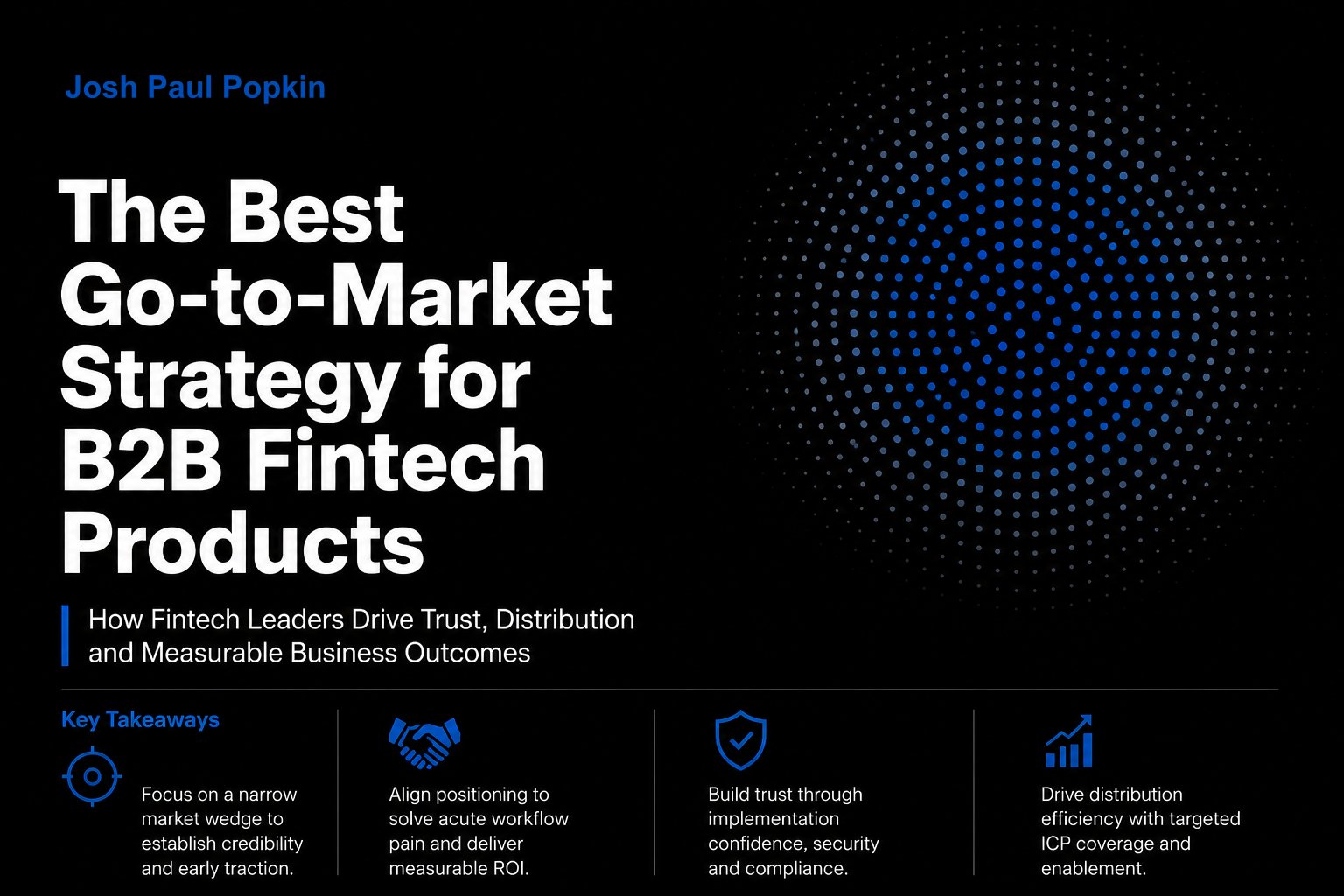
Written by Josh Popkin. Published May 28, 2026.
The central misconception in B2B fintech is the belief that product sophistication alone creates market advantage. Founders frequently assume that differentiated infrastructure, superior underwriting models, modern payment orchestration, or deeply technical financial workflows will naturally translate into durable growth. In practice, however, fintech success is rarely a function of product capability in isolation. It is a function of trust, distribution, implementation confidence, and strategic narrative alignment.
Unlike horizontal SaaS, B2B fintech products sit within highly sensitive operational environments characterized by financial risk, regulatory scrutiny, workflow dependency, and elevated switching costs. Buyers are not simply adopting software; they are re-architecting mission-critical systems tied to money movement, treasury visibility, reconciliation, fraud mitigation, compliance workflows, ledger integrity, or revenue realization. As a result, fintech go-to-market strategy cannot rely on generic SaaS playbooks optimized for top-of-funnel growth or broad category awareness. Winning fintech GTM motions are built around precision ICP targeting, acute workflow pain, measurable business outcomes, and trust-based adoption mechanics.
The strongest fintech companies recognize that distribution efficiency begins with focus. Rather than pursuing a large theoretical TAM through broad positioning, they establish a highly opinionated market wedge anchored in a narrowly defined customer segment experiencing disproportionate operational friction. Weak positioning often manifests through abstract platform language such as “modern financial infrastructure,” “embedded finance enablement,” or “AI-powered treasury orchestration.” While intellectually appealing, these narratives frequently fail to create urgency because they are disconnected from buyer-level economic pain.
A more effective approach maps product positioning directly to operational and financial outcomes. Instead of describing a generalized platform capability, category-leading fintech PMMs frame value around measurable business impact: reduction in failed payouts, acceleration of month-end close, fraud loss minimization, improved authorization rates, enhanced liquidity visibility, or reconciliation automation. The strategic objective is to collapse technical sophistication into business relevance. Buyers rarely purchase architecture; they purchase operating leverage, risk reduction, and measurable ROI.