AI
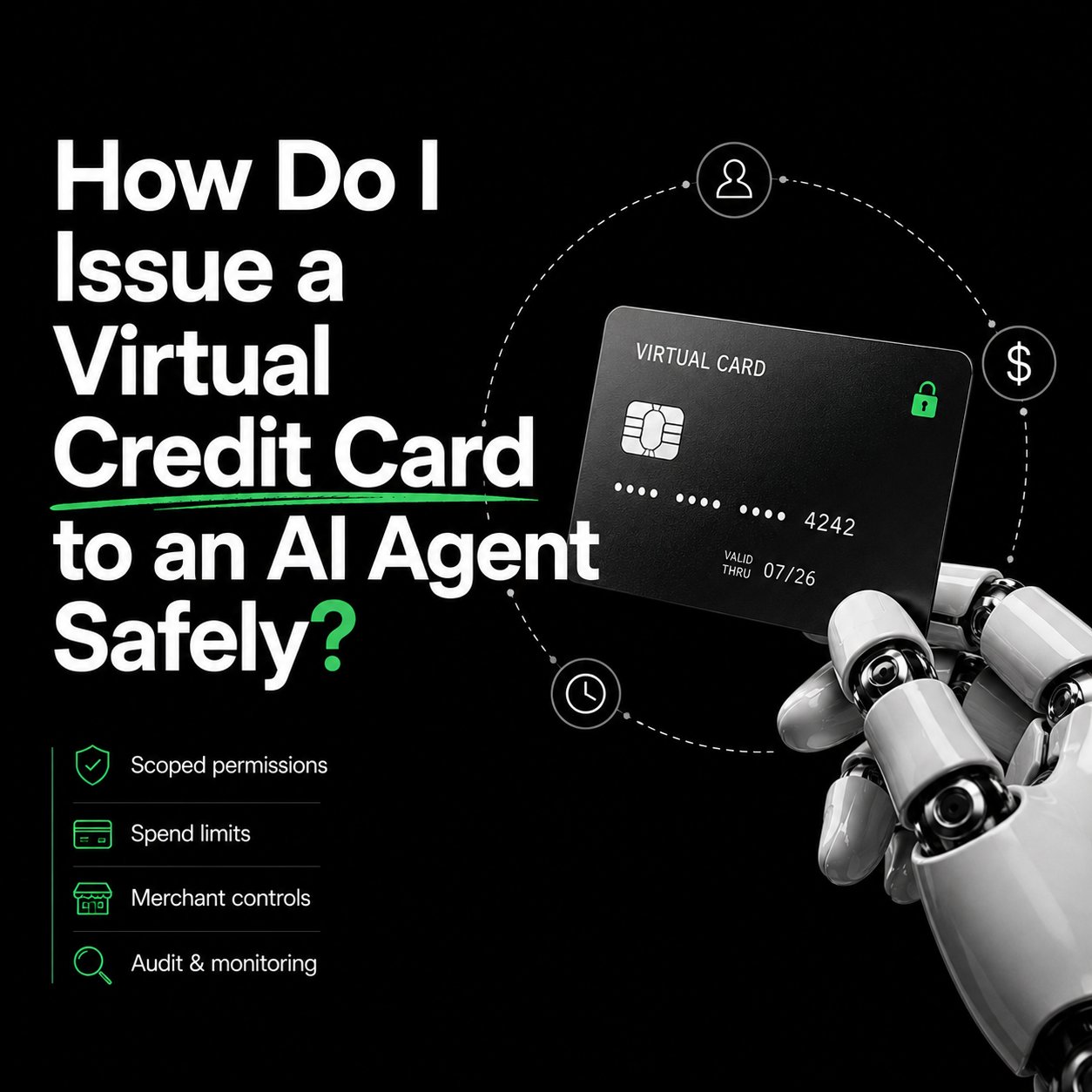
How Do I Issue a Virtual Credit Card to an AI Agent Safely?
One of the stranger questions emerging in fintech right now is:
The emerging playbook for letting software spend money without losing control
One of the stranger questions emerging in fintech right now is:
How do you safely let AI spend money?
Not recommend purchases.
Not suggest actions.
Actually transact.
Imagine an AI agent tasked with:
renewing software subscriptions
purchasing cloud resources
booking travel
paying vendors
buying domains
placing operational orders
The obvious instinct sounds dangerous:
just give the AI a company card
That is precisely what companies should not do.
Because the future of agentic commerce is probably not:
autonomous spending
It is:
guardrailed spending¹
The safer model increasingly looks like this:
issue a tightly controlled virtual payment credential to an AI agent for a narrowly defined task.
In other words:
you do not give an AI your credit card.
You give it:
temporary, observable, permissioned access to spend.
First: never expose a real corporate card
The first rule of safe agentic payments is surprisingly simple:
**never give an AI agent unrestricted financial credentials.**¹²
No finance team wants:
GPT with the company Amex
Instead, the emerging pattern uses:
virtual cards
Virtual cards are digitally generated payment credentials that can be created, restricted, and revoked programmatically.³
Unlike a traditional card, a virtual card can be:
single-use
merchant-restricted
time-bound
amount-limited
revocable instantly
This dramatically changes the risk profile.
Instead of:
unlimited financial access
you create:
purpose-built payment permissions
For example:
An AI procurement agent buying a domain might receive:
a one-time virtual card capped at $75, valid for 30 minutes, restricted to a specific registrar.
That looks much safer.
Think of the card as a permission token
This is probably the most important conceptual shift.
Historically, a payment card represented:
access to money
In agentic commerce, the card increasingly becomes:
a permission system for tasks¹²
The framing shifts from:
here is spending access
to:
here is permission to complete one bounded workflow
For example:
A travel-booking agent could receive permission to:
purchase airfare
spend under $1,200
transact only with approved airlines
expire after booking completes
A procurement agent could receive permission to:
renew software licenses
transact only with pre-approved vendors
remain active for 24 hours
The product logic becomes:
least-privilege finance
A familiar concept in cybersecurity, now applied to money movement.
Scope permissions aggressively
This is where safety becomes practical.
The safest systems assume:
agents will eventually make mistakes
The goal is not perfect intelligence.
The goal is bounded failure.⁴
Emerging payment infrastructure increasingly allows companies to constrain virtual payment credentials across dimensions such as:
Merchant restrictions
Only approved merchants.
Example:
AWS, Google Cloud, Zoom
—not random ecommerce websites.²
Spend limits
Maximum transaction amount.
Maximum daily spend.
Maximum aggregate spend.¹
Example:
up to $300
—not:
unlimited purchasing authority
Time windows
Cards expire automatically after:
minutes
hours
completion of task
This reduces persistent exposure dramatically.³
Category restrictions
Only certain merchant categories allowed.
Example:
software infrastructure
but not:
travel, retail, entertainment
This matters because AI mistakes are inevitable.
The safest architecture assumes failure will happen and limits blast radius.
Human approval still matters
One of the biggest misconceptions about agentic commerce is that autonomy means:
no humans involved
In practice, emerging systems increasingly resemble:
delegated autonomy
A more realistic model looks like:
Under $100→ autonomous execution
$100–$1,000→ approval notification
$1,000+→ human authorization required
In other words:
software executes within rules humans define.²⁵
This matters because enterprise finance ultimately optimizes for:
trust
not novelty.
A CFO does not want:
AI making purchasing decisions
They want:
AI handling approved workflows safely
That is a much easier sell.
Observability matters as much as permissions
Even tightly scoped permissions are insufficient without visibility.
If agents begin transacting, companies will increasingly need:
audit logs
spend monitoring
approval trails
transaction history
revocation systems
Every action should answer:
What happened?
Why did it happen?
What system authorized it?
Who approved the permission layer?
This is increasingly how payment companies frame agentic commerce:
autonomy with accountability¹²⁶
The future probably looks less like:
autonomous AI buyers
and more like:
highly observable software operators
Identity becomes financial infrastructure
There is also a deeper infrastructure problem underneath all of this:
How do systems know which agent is authorized to act?
Historically, payments verified humans.
Passwords.
MFA.
KYC.
Identity checks.
Agentic commerce introduces a new problem:
delegated identity
Questions emerge quickly:
Which AI agent initiated the transaction?
Who granted permission?
What task was it authorized to complete?
When does that permission expire?
This explains why payment companies increasingly talk about:
trusted agentstokenized permissionsdelegated authentication
—not simply AI payments.²⁶
The infrastructure problem is really:
financial trust for software
So what would a safe AI card actually look like?
If I had to summarize the emerging playbook:
A safe AI payment credential would likely look something like:
Purpose: Renew cloud software
Spend limit: $500
Merchant restrictions: AWS, Google Cloud, Datadog
Expiration: 12 hours
Approval threshold: Human review above $300
Observability: Full audit logs enabled
Revocation: Immediate
In practice:
not a corporate card
More like:
programmable financial permission
That distinction feels important.
Because the future of AI commerce likely depends less on intelligence and more on control.
A PMM takeaway
The strongest fintech companies in agentic commerce probably will not market:
AI that spends money
They will market:
safe execution inside human-defined boundaries
That positioning matters.
Because buyers rarely purchase autonomy.
They purchase confidence.
Not:
autonomous procurement
But:
faster operations with less risk
Not:
AI payments
But:
trusted execution
The products that win this category will not simply let software transact.
They will make businesses comfortable letting software transact.
Footnotes
National Institute of Standards and Technology (NIST) Least Privilege Principle
McKinsey on Generative AI in Financial Services
Security of Autonomous LLM Agents in Agentic Commerce (arXiv)
Written by Josh Popkin. Published May 25, 2026.
Disclaimer: This content is for informational and educational purposes only and reflects personal analysis and opinions. It should not be considered financial, investment, legal, or professional advice. Always conduct your own research and consult qualified professionals before making financial or business decisions.