Business
Is Adyen a payment gateway, an acquirer, or a processor?
Why one of fintech’s largest companies is difficult to categorize
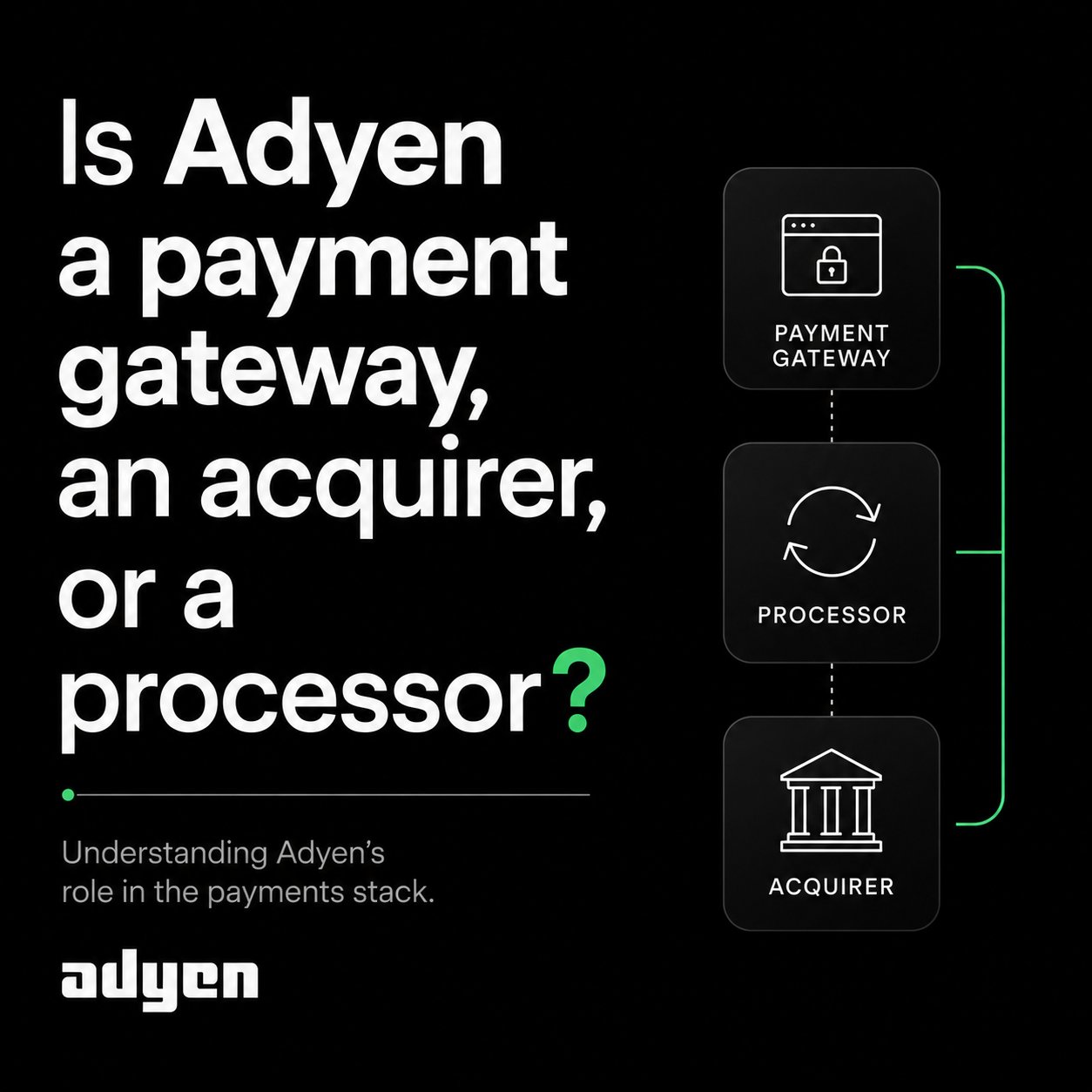
Why one of fintech’s largest companies is difficult to categorize
At some point, anyone who spends enough time around payments eventually asks the same question:
What exactly is Adyen?
A payment gateway?
A processor?
An acquirer?
A PSP?
The confusion is understandable because the short answer is:
**all of the above.**¹
But the more interesting answer is this:
Adyen is difficult to categorize because it was intentionally designed to collapse multiple layers of the payments stack into a single platform.
That distinction matters.
Because understanding why Adyen feels hard to define reveals something important about how modern payments infrastructure evolved.
Why payments terminology feels unnecessarily confusing
Payments is one of those industries where simple customer problems sit on top of surprisingly complicated infrastructure.
A merchant wants to do something straightforward:
accept money
Behind the scenes, however, multiple institutions and vendors may participate in making that happen:
payment gateways
processors
merchant acquirers
card networks
issuing banks
fraud systems
reporting infrastructure
Historically, merchants stitched together these functions across multiple vendors.²
A retailer might rely on:
one company for gateway services
another for payment processing
an acquiring bank for settlement
separate vendors for fraud prevention and reporting
The result was complexity.
Multiple integrations.
Multiple contracts.
Operational fragmentation.
Adyen emerged in response to this problem.
First: what do these terms actually mean?
Before understanding Adyen, it helps to define the underlying layers.
Payment gateway
A payment gateway is the software layer that securely transmits payment information between a merchant and the broader payments ecosystem.³
In practical terms:
it moves payment information
When a customer enters card details online, the gateway securely routes transaction data for authorization.
Think:
payment communication infrastructure
Historically, gateways acted as connective tissue between merchants and financial systems.
Payment processor
A payment processor manages the technical orchestration of payment transactions.⁴
Processors facilitate the flow of transaction information among:
merchants
acquiring institutions
card networks
issuing banks
In practical terms:
processors help transactions happen
Authorization requests move through processors.
Settlement instructions move through processors.
Transaction information moves through processors.
Think:
transaction orchestration
Merchant acquirer
An acquirer — sometimes called a merchant acquirer or acquiring bank — enables businesses to accept card payments.⁵
Acquirers:
sponsor merchant access to card networks
settle funds
underwrite merchant risk
manage payment acceptance relationships
If a merchant wants to accept Visa or Mastercard, an acquiring relationship generally exists somewhere in the stack.
Think:
merchant enablement and settlement
Historically, this layer sat primarily with banks.
So what is Adyen?
The short answer:
**Adyen is effectively all three.**¹
Adyen combines:
payment gateway functionality
payment processing
merchant acquiring
inside one platform.¹
This architecture is one of the reasons Adyen became strategically important in global commerce.
Instead of merchants assembling fragmented payments infrastructure across multiple vendors, Adyen increasingly offers:
one integrated system for accepting, processing, routing, and settling payments
That simplification matters.
Instead of managing:
gateway → processor → acquirer → reporting systems
companies increasingly operate inside:
one payments environment
Adyen itself describes this model as an end-to-end financial technology platform, combining acquiring, payment processing, optimization, reporting, and financial products into a unified system.¹
Why this matters strategically
The more important question is not:
What category does Adyen belong to?
It is:
Why was Adyen designed to blur category boundaries?
The answer is operational simplicity.
Historically, fragmented payment stacks created friction:
inconsistent reporting
reconciliation complexity
fragmented authorization logic
vendor coordination issues
slower international expansion
Vertical integration changes the equation.
When more of the payments stack sits inside one system, merchants can optimize:
authorization performance
fraud management
reporting consistency
omnichannel experiences
global expansion
This helps explain why Adyen gained traction among large multinational merchants operating across geographies, currencies, and payment methods.⁶
The customer problem Adyen solves is not:
payments infrastructure complexity
The customer outcome becomes:
global payment acceptance with less operational friction
That distinction is important.
Because customers rarely buy infrastructure categories.
They buy simpler operations.
Why Adyen feels difficult to categorize
One reason Adyen confuses people is that payments historically evolved through specialization.
Different companies handled different jobs.
Gateways moved data.
Processors coordinated transactions.
Acquirers managed merchant access and settlement.
Reporting often lived elsewhere.
Fraud tooling sat elsewhere.
The stack fragmented over time.
Adyen’s strategy was effectively the opposite.
Instead of specializing in one layer, it collapsed multiple layers into one product experience.¹
The resulting company becomes difficult to describe using traditional payments terminology because those terms were built around separation.
Adyen’s product strategy is integration.
That is precisely why the answer to:
“Is Adyen a gateway, processor, or acquirer?”
feels unsatisfying.
Because the company was intentionally designed to be more than one thing.
A PMM takeaway
Adyen is a useful reminder that strong fintech companies often win by abstracting complexity rather than exposing it.
Customers do not care about payment-layer taxonomy.
They care about outcomes:
fewer failed payments
simpler reporting
easier global expansion
less operational friction
faster execution
The infrastructure becomes more complicated.
The product story becomes simpler.
And increasingly, that pattern defines some of the strongest companies in fintech.
Footnotes
Adyen Platform Overview; Adyen About & Financial Technology Platform Overview
Visa: What Is a Payment Gateway?
Mastercard Merchant & Payment Processing Overview
Guide to Merchant Acquirers
Written by Josh Popkin. Published May 25, 2026.