Stablecoins
Meta Paying Creators in Stablecoins Isn’t a Crypto Story — It’s a Product Marketing Story
I was watching Stripe Sessions 2026 this week when one announcement made me stop scrolling. Not AI agents. Not checkout. Not infrastructure.
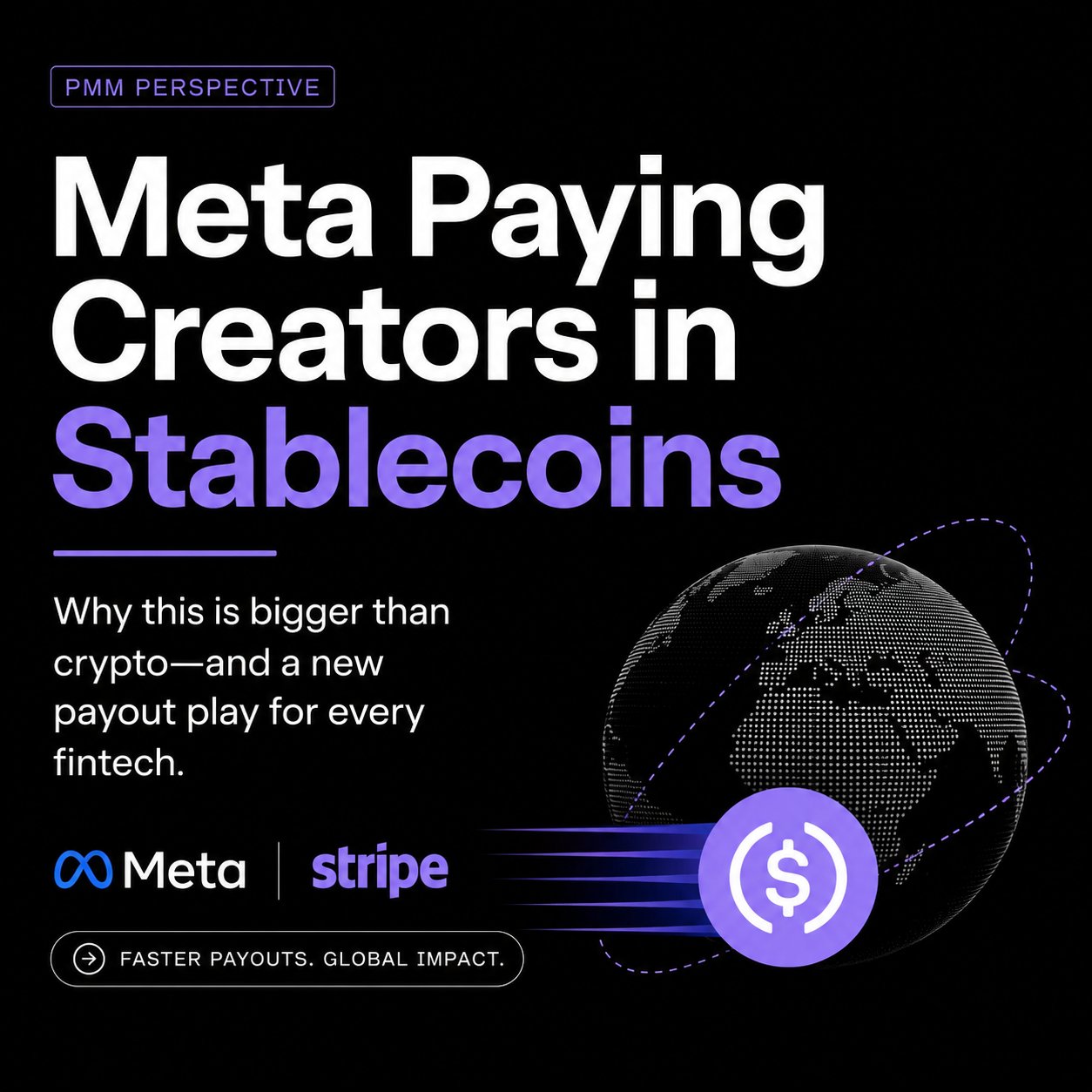
I was watching Stripe Sessions 2026 this week when one announcement made me stop scrolling.
Not AI agents.
Not checkout.
Not infrastructure.
It was this: Meta is beginning to pay select creators in stablecoins.
At first glance, this sounds like another “crypto is back” headline. It isn’t.
As someone who thinks about fintech product marketing, I think this moment matters for a very different reason:
Stablecoins are quietly becoming payout infrastructure.
And the companies that win will not market “crypto.”
They’ll market getting paid faster.
The problem nobody likes talking about: payouts kind of suck
Payments get all the attention in fintech.
Payouts are the boring cousin.
But if you are a creator, freelancer, marketplace seller, gig worker, or contractor living outside the U.S., payouts are often the worst part of the experience.
You finish the work.
Then you wait.
And wait.
Maybe you lose money to FX fees. Maybe your bank takes days. Maybe your local rails are unreliable. Maybe an intermediary takes a cut.
For creators especially, delayed payouts create a weird emotional disconnect.
You made money today.
Why does it feel unavailable?
That is the problem stablecoins are suddenly very good at solving.
At Stripe Sessions, the messaging around stablecoins felt noticeably different than even a year ago. The pitch was less “crypto future” and more “money movement infrastructure”: faster settlement, lower cost, broader global reach, and programmable rails for payouts. Stripe announced expanded global stablecoin payout capabilities, allowing businesses to send funds to recipients in more than 160 countries.
That framing matters.
Because product marketing is often about reframing technology into outcomes people actually care about.
Why Meta’s move matters
According to reporting and Meta’s own support materials, select creators in countries including Colombia and the Philippines can now receive creator earnings in USDC via supported crypto wallets, powered through Stripe infrastructure.
That sounds niche.
It isn’t.
The important part is not “creator wallets.”
The important part is this:
One of the largest consumer platforms in the world just decided stablecoins are good enough for payouts.
That changes the narrative.
For years, crypto products were marketed around speculation:
Trade faster
Buy coins
Invest early
“The future of finance”
Meta is implicitly positioning stablecoins differently:
“Want to get paid faster?”
That is an infinitely better product story.
Because nobody wakes up wanting blockchain.
People want:
Money now
Fewer fees
Reliability
Global access
The blockchain part is implementation detail.
Good fintech PMMs should pay attention to that.
The best fintech products hide complexity
This is the real PMM lesson.
Consumers do not care about payment rails.
Nobody says:
“Wow, I’m excited to use ACH today.”
Nobody says:
“Can’t wait to experience card acquiring.”
And soon, nobody will say:
“I want stablecoins.”
They will say:
“I got paid instantly.”
The best infrastructure products disappear.
Cloud computing disappeared.
APIs disappeared.
Card tokenization disappeared.
Stablecoins are headed in the same direction.
In fact, this may be the first time we are seeing stablecoins marketed primarily as an experience improvement, not a financial ideology.
That feels like a major shift.
Stablecoins are becoming the backend, not the product
The easiest mistake fintech companies can make is over-marketing the technology.
A lot of crypto products historically led with complexity:
Wallets
Chains
Protocols
Gas fees
Self-custody
Most users do not care.
And frankly, they shouldn’t.
The PMM challenge is translating infrastructure into customer value.
The messaging should probably sound more like:
Before:“Receive creator payouts on-chain using USDC.”
After:“Get paid globally in minutes.”
One of those is crypto-native.
The other is mass-market.
Guess which one wins.
Stripe itself increasingly frames stablecoins this way—speed, cost reduction, cross-border reach, and instant settlement rather than speculative upside. Sessions content repeatedly emphasized businesses paying sellers faster, moving money globally, and reducing friction in internet commerce.
Why creators are the perfect wedge market
If I were building fintech GTM around stablecoin payouts, creators are exactly where I would start.
Why?
Because creator income is:
Cross-border
Irregular
Often time-sensitive
Emotionally tied to engagement and performance
If you post content and earn money today, waiting five business days feels absurd.
Stablecoin payouts solve a surprisingly emotional problem:
They reduce the psychological distance between earning and receiving.
That matters more than people think.
And creators are culturally influential.
If creators normalize receiving digital-dollar payouts, marketplaces, freelancer platforms, payroll systems, and gig economy products are not far behind.
Today it is creator monetization.
Tomorrow it becomes:
Marketplace seller payouts
Contractor payments
Global payroll
Affiliate commissions
Gig-worker earnings
B2B disbursements
That trajectory increasingly aligns with how Stripe is positioning stablecoin payouts—as global money movement infrastructure rather than a niche crypto feature.
But there is still a product problem
This does not mean adoption is automatic.
Stablecoins still have a UX problem.
If the flow requires users to understand:
Wallet setup
Network selection
On/off ramps
Tax implications
Private keys
…you have already lost mainstream adoption.
The winners here will obsess over abstraction.
The ideal experience probably looks like this:
You earned money → you got paid → done.
No crypto vocabulary.
No education center.
No onboarding course.
Just better money movement.
Ironically, success for stablecoins may mean users barely realize they are using them.
The biggest PMM lesson: sell outcomes, not innovation
Fintech teams love talking about infrastructure.
Customers do not.
This is the same reason nobody markets databases.
Or payment orchestration.
Or treasury APIs.
The product marketer’s job is translating systems into feelings.
Stablecoins are not the story.
The story is:
“You earned money. You have it now.”
That is emotionally resonant.
That is easy to understand.
And that is probably how stablecoins go mainstream.
Because the companies that win will not convince consumers to care about crypto.
They will convince consumers to stop noticing payments altogether.
Footnotes
Stripe Sessions 2026 announcements blog (April 2026), including global stablecoin payout expansion.
Stripe newsroom: Sessions 2026 announcements (April 2026).
Meta Business Help Center: Stablecoin payouts with Meta (accessed May 2026).
CoinDesk reporting on Meta creator payouts in USDC via Stripe (April 29, 2026).
Finance Yahoo reporting on Meta stablecoin payouts rollout (May 2026).
Stripe Sessions: The Stablecoin Advantage — Faster Growth, Fewer Borders (April 2026).
Stripe Sessions: Fiat infrastructure meets stablecoin speed (April 2026).
This piece of content was written by Josh Popkin, published on May 25, 2026.