Stablecoins
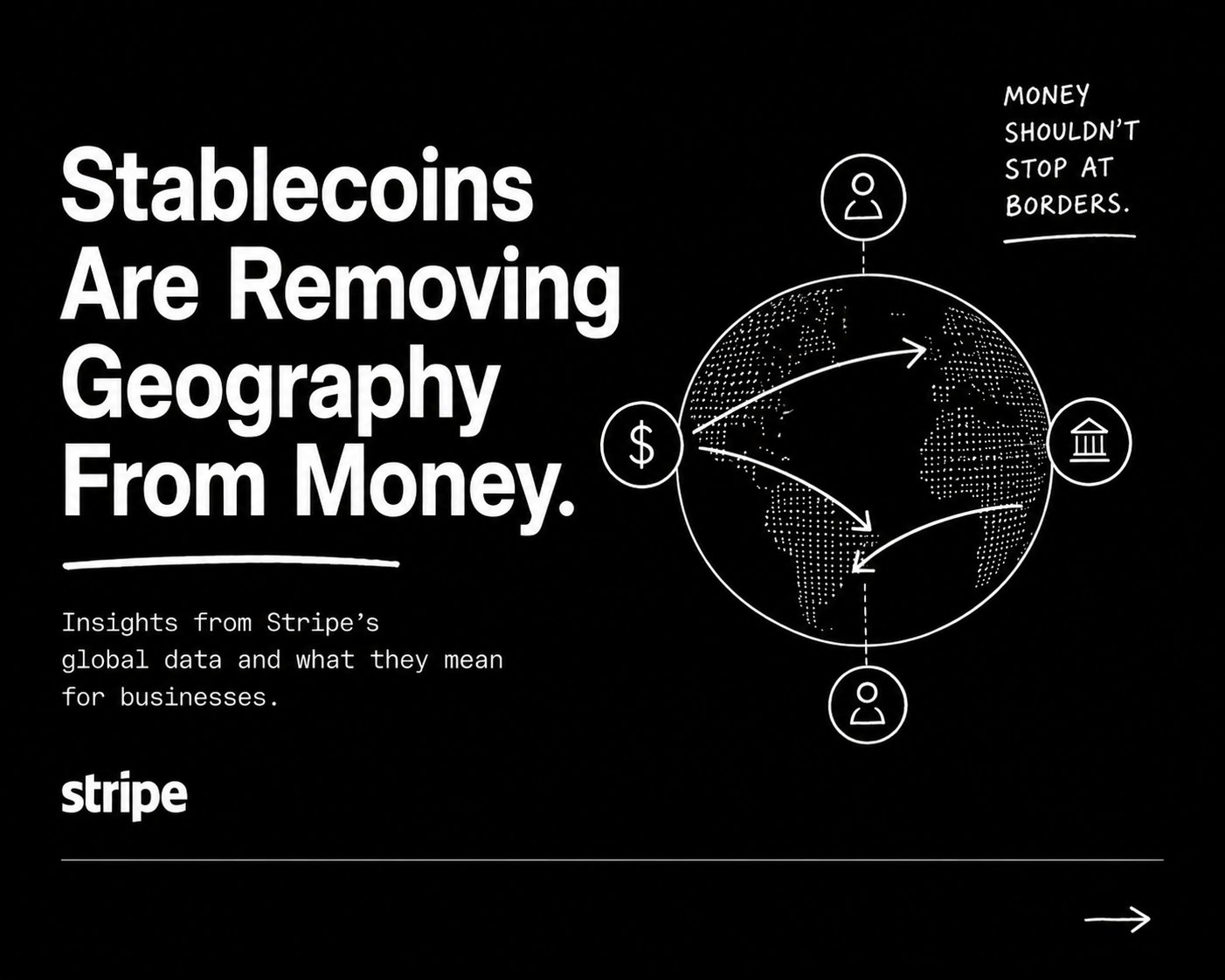
Stablecoins Are Removing Geography from Money
For most of modern history, geography determined how money moved.
By Josh Paul Popkin. Published June 17, 2026.
For most of modern history, geography determined how money moved.
Where you lived influenced how quickly you got paid, which financial products you could access, and how expensive it was to transact across borders.
The internet largely eliminated geography from communication. Stablecoins may do the same for money.
At a recent discussion on stablecoin trends from Stripe's global data, Ben Yukich shared a statistic that caught my attention: approximately 10% of U.S.-Mexico remittances now move through stablecoins, representing roughly $6 billion annually.
The significance of that number extends beyond payments.
It reflects a broader shift in how businesses are beginning to think about financial infrastructure.
Traditional payment rails were built for a world where commerce was largely domestic. Today's businesses operate very differently. Customers are global. Workforces are distributed. Commerce increasingly occurs across borders rather than within them.
The underlying infrastructure has struggled to keep pace.
Cross-border payments remain slower, more expensive, and more complex than the movement of information itself. While software, content, and communication became global decades ago, money has remained constrained by national boundaries.
Stablecoins are beginning to change that dynamic.
The most immediate application is cross-border payments. Companies can reach customers in more markets, distribute funds globally, and provide financial services without many of the constraints associated with traditional payment rails.
Examples are already emerging. Meta uses Stripe infrastructure to facilitate creator payouts in markets such as the Philippines and Colombia. What was once operationally difficult is becoming increasingly straightforward.
More importantly, the economics are changing.
Historically, moving money was viewed as a cost of doing business. Success meant minimizing fees and reducing friction.
Increasingly, financial infrastructure is becoming a source of competitive advantage.
Faster payouts improve customer experience. Borderless financial services expand addressable markets. Global money movement creates opportunities that were previously uneconomical to pursue.
In other words, money movement is evolving from a back-office function into a product capability.
This trend becomes even more relevant when viewed through the lens of agentic commerce.
As AI systems begin conducting transactions on behalf of users and businesses, they will require financial infrastructure that is programmable, global, and available continuously. The systems that enable those capabilities will capture disproportionate value.
The most important takeaway is not that stablecoins are cheaper or faster.
It is that they are reducing the importance of geography in financial services.
The internet removed geography from communication.
Stablecoins are beginning to remove geography from money.