Fintech
Stripe, the “Singularity,” and What B2B Fintech PMMs Should Actually Pay Attention To
I recently watched the 2026 opening remarks at Stripe’s annual conference, and one phrase kept resurfacing: the singularity.
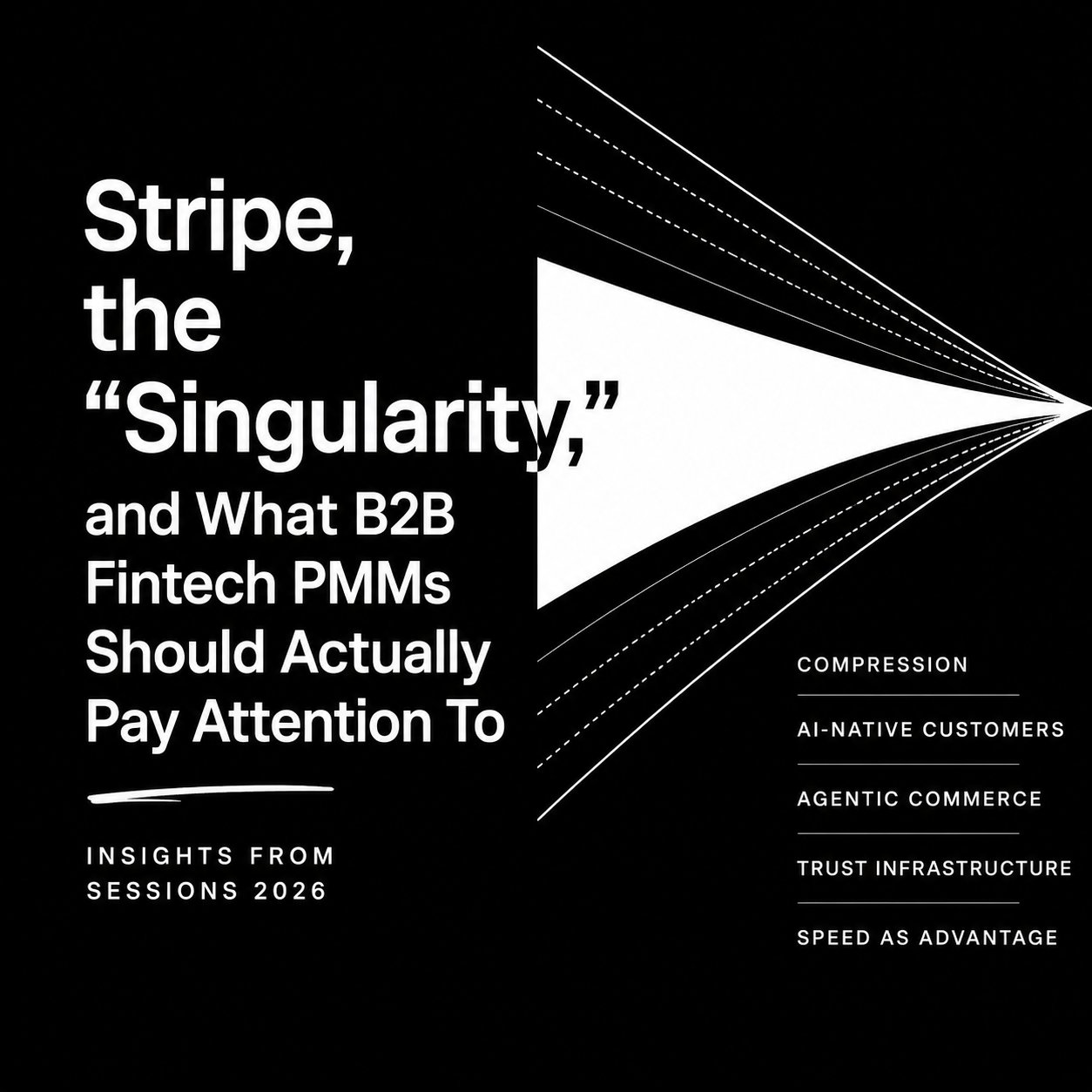
Not in the cinematic sense. Not as a prediction of sentient AI replacing humans next quarter. But as a framing for something that feels increasingly real to anyone working in technology — especially in B2B fintech: the pace of change is accelerating, and increasingly, it feels nonlinear.
At multiple points, Stripe referenced being on “day X of the singularity.” What struck me wasn’t the provocation of the term itself, but what the phrase seemed to signal beneath the surface.
As someone who writes about fintech product marketing, I found myself thinking: maybe the important story here isn’t the singularity at all.
Maybe it’s compression.
The real singularity in fintech is compression
When most people hear “singularity,” they imagine intelligence surpassing human capability or a dramatic technological break from the past.
But watching Stripe Sessions, I interpreted something more operational and more economically relevant.
Everything is compressing.
Product development cycles are compressing. Company formation is compressing. Global expansion is compressing. Experimentation cycles are compressing. Time between idea and monetization is compressing.
A few years ago, launching globally, standing up payments infrastructure, managing tax compliance, fighting fraud, and operationalizing finance required enormous institutional coordination.
Increasingly, infrastructure companies are abstracting that away.
If you’re a founder — or a PMM serving founders — the expectation has quietly shifted from Can we do this? to Why hasn’t this launched already?
That shift matters.
Because when operating speed changes, customer expectations change with it.
And when customer expectations change, positioning has to change too.
What I think Stripe is really signaling
One thing I appreciated about Stripe Sessions is that beneath the product launches, there was an implied thesis.
The world is moving faster, and infrastructure needs to move with it.
That sounds obvious, but in fintech, it represents a meaningful repositioning.
Historically, financial infrastructure sold reliability.
Security. Compliance. Scale. Enterprise readiness.
Those things still matter deeply. In regulated industries, they always will.
But increasingly, speed itself becomes part of the value proposition.
Not speed in the vague startup sense.
Operational speed.
How quickly can a company launch in a new market? How quickly can it test a pricing model? How quickly can an AI-native startup monetize, iterate, or onboard users globally?
If the cost of building falls dramatically because of AI, the bottleneck shifts elsewhere.
Payments.
Identity.
Authorization.
Trust.
Risk.
Settlement.
In other words: fintech infrastructure becomes even more strategically important, not less.
AI changes who your customer is
The part of the “singularity” conversation I think fintech PMMs should pay closer attention to is this:
What happens when software itself becomes an economic participant?
We are moving toward a world where AI agents can initiate actions, make recommendations, potentially transact, and coordinate workflows at a scale humans simply cannot.
Whether we call them agents, copilots, or automation layers almost doesn’t matter.
What matters is this: systems will increasingly participate in commerce.
And if systems participate in commerce, trust infrastructure becomes essential.
That creates a fascinating shift for fintech.
The product conversation is no longer only:
How do we help humans transact safely?
It increasingly becomes:
How do we help autonomous systems transact safely, transparently, and accountably?
Identity verification looks different.
Fraud detection looks different.
Permissioning looks different.
Auditability becomes more important.
Authentication becomes more nuanced.
Even something as simple as “who approved this payment?” starts to evolve.
For fintech product marketers, this means messaging maturity matters more than ever. We can’t position infrastructure as plumbing anymore.
We have to position it as an enabler of economic trust.
The PMM implication: speed becomes positioning
Here’s the practical implication I kept returning to while watching Sessions.
In fintech, products are marketed around reliability, breadth, or efficiency.
Those remain table stakes.
But increasingly, I think the winning narrative becomes:
We reduce time-to-value.
We reduce friction between ambition and execution.
We help companies move faster without increasing risk.
That sounds subtle, but it changes messaging.
Instead of:
“Comprehensive payments infrastructure”
The underlying customer promise becomes:
“Launch faster. Expand faster. Experiment faster.”
Instead of infrastructure as complexity management, infrastructure becomes acceleration.
If AI compresses build time, fintech companies that compress operational time become disproportionately valuable.
That feels like one of the clearest strategic signals embedded in Stripe’s framing.
Why I actually liked the singularity reference
I’ll admit: the phrase initially made me roll my eyes.
“The singularity” can sound overly grandiose, especially in tech.
But the more I thought about it, the more I appreciated what Stripe may have been trying to do.
Good positioning creates a frame.
And “the singularity” is an effective frame because it forces people to stop debating incrementalism.
Whether or not one believes in AGI timelines is almost beside the point.
The useful question is:
What if the pace of economic and technological change accelerates faster than our organizations are built to handle?
That feels deeply relevant to fintech.
And deeply relevant to PMMs.
Because in moments of market transition, product marketers are not just storytellers.
We're translators.
We help customers understand what changed, why it matters, and what to do next.
If Stripe’s message was “it’s going to happen fast,” my interpretation is simpler:
The companies that win won’t necessarily be the ones with the most features.
They’ll be the ones that help customers move with confidence at a new speed.
That, to me, is the most interesting version of the singularity.