Entrepreneurship
What Is Entrepreneurship?
Entrepreneurship is the process of identifying an opportunity, taking on the financial and personal risk required to pursue it, and building an organization to deliver something…
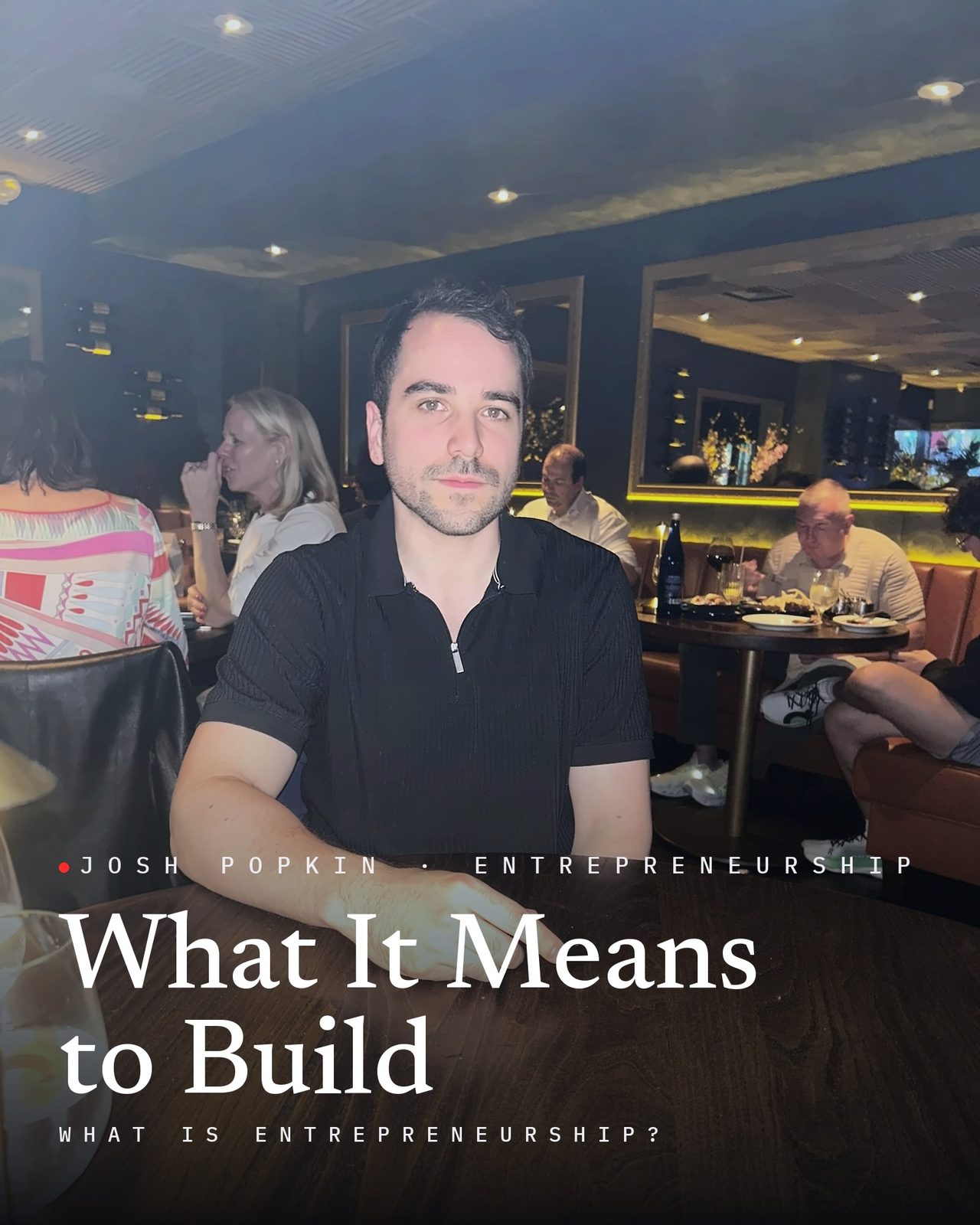
By Josh Popkin, MBA
Entrepreneurship is the process of identifying an opportunity, taking on the financial and personal risk required to pursue it, and building an organization to deliver something of value that didn't exist in that form before. It's not a job title or a personality type — it's a specific activity: converting an idea into a functioning business, under real uncertainty, with no guarantee it works.
What's the Actual Definition, Beyond "Starting a Business"?
The most influential academic definition comes from Harvard Business School professor Howard Stevenson, who described entrepreneurship as the pursuit of opportunity beyond the resources currently controlled — meaning an entrepreneur commits to a goal before they actually have everything needed to reach it, and figures out the rest along the way. That's the part that separates entrepreneurship from ordinary business management: a manager typically optimizes resources that already exist; an entrepreneur commits to an outcome first and assembles the resources afterward, often improvising capital, talent, and infrastructure as they go.
Economist Joseph Schumpeter offered the other foundational framing: entrepreneurship as "creative destruction" — the entrepreneur's role is to introduce new combinations of products, methods, markets, or organizational forms that disrupt and eventually replace the existing order. Under that view, entrepreneurship isn't just business creation, it's a driver of economic change itself, which is part of why economists treat it as distinct from self-employment or small business ownership generally.
Is Every Small Business Owner an Entrepreneur?
Not by the stricter definitions, and this distinction matters. Opening a business that replicates an existing, proven model — a franchise location, a local service business run the way similar ones already run — is a legitimate and valuable path, but it isn't the same activity Schumpeter or Stevenson were describing. The defining feature of entrepreneurship specifically is novelty paired with genuine risk: building something that didn't exist in that form, without a guaranteed playbook, versus operating a known model well. Both take real skill. Only one is entrepreneurship in the technical sense.
What Actually Makes Someone Take the Leap?
Research on entrepreneurial motivation consistently identifies a mix of two forces: opportunity-driven motivation (seeing a specific gap or possibility worth pursuing) and necessity-driven motivation (starting a venture because other options are limited or unavailable). Opportunity-driven entrepreneurship tends to correlate with stronger long-term outcomes, but necessity-driven ventures are a significant share of new business formation globally, particularly in markets with fewer traditional employment options.
Beyond motivation, the trait most consistently associated with entrepreneurial success across studies isn't raw risk tolerance — it's tolerance for ambiguity: the capacity to keep operating effectively without a clear, validated plan, because early-stage ventures rarely have one.
What Does the Actual Process Look Like?
Stripped of romanticism, entrepreneurship follows a fairly consistent structural pattern, regardless of industry:
Opportunity recognition — identifying a gap between what currently exists and what could exist, often before it's obvious to anyone else.
Resource assembly under constraint — securing capital, people, and infrastructure without full certainty the venture will work, frequently starting with far less than the venture will eventually require.
Validation through real-world contact — testing the idea against actual customers, not projections, which is where most ventures first discover the gap between the plan and reality.
Iteration based on failure, not despite it — adjusting the model based on what real customers actually do, not what the original plan assumed they would do.
That fourth step is the one most consistently underweighted in how entrepreneurship gets talked about publicly. The popular image is the idea and the launch. The actual work is almost entirely what happens after the first version of the idea turns out to be wrong in some specific, correctable way.
Why Does This Distinction — Thinking vs. Doing — Matter So Much in Practice?
Because the opportunity-recognition stage is where entrepreneurship is safest, and the resource-assembly and validation stages are where it's genuinely risky — and a huge number of viable ideas never make that transition. It's entirely possible to construct a flawless mental model of a business that would work; it's a completely different thing to expose that model to a real customer who's allowed to say no. The idea is the easy 5% of entrepreneurship. Testing it against reality is the other 95%, and it's the part that actually determines whether an opportunity becomes a business or stays a thought experiment.
Citations
Stevenson, Howard H. "A Perspective on Entrepreneurship." Harvard Business School Working Paper, 9-384-131, 1983.
Schumpeter, Joseph A. Capitalism, Socialism and Democracy. Harper & Brothers, 1942.
"Necessity vs. Opportunity Entrepreneurship." Global Entrepreneurship Monitor, https://www.gemconsortium.org/.